
Most founders believe choosing an MLM software development company is similar to hiring a web development agency.
It isn’t.
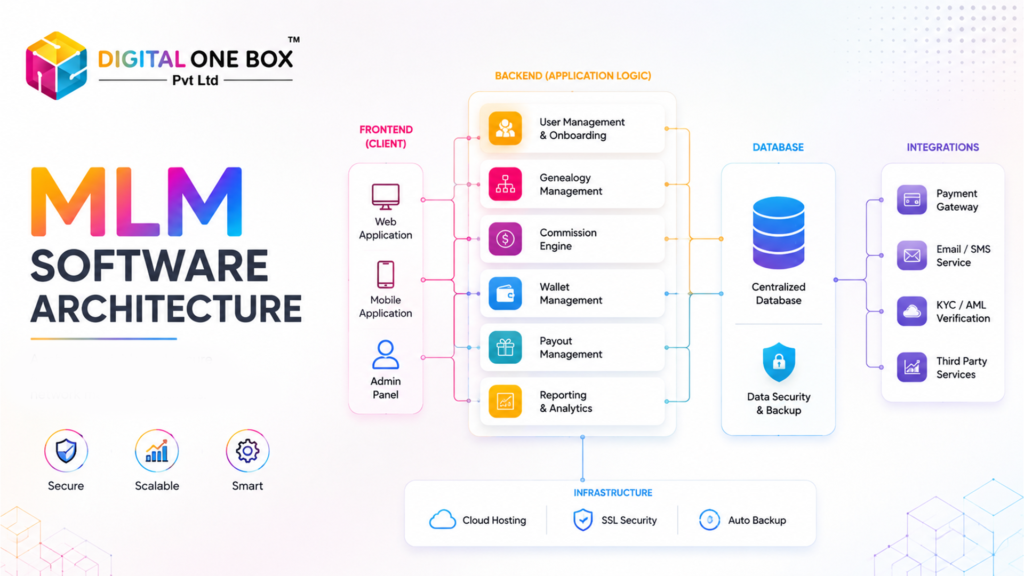
An MLM platform is not simply a website with registration forms and dashboards. Behind every successful MLM business is an extremely complex financial engine processing thousands—or sometimes millions—of transactions, commission calculations, genealogy updates, wallet balances, and payout requests simultaneously.
A single commission error can trigger hundreds of distributor complaints.
A payout delay can permanently damage trust.
A poorly designed genealogy engine can become unusable once the network begins growing.
Unfortunately, many businesses only discover these limitations after launching, when fixing the underlying architecture becomes expensive and disruptive.
At Digital One Box, we’ve worked on numerous blockchain ecosystems, fintech applications, and MLM software architectures. One lesson consistently stands out:
Most MLM software failures are not caused by poor UI—they’re caused by poor backend architecture.
This guide explains the five technical areas experienced buyers evaluate before selecting an MLM software development company.
More importantly, it highlights the questions most vendors hope clients never ask.
Why Technical Expertise Matters More Than Portfolio Screenshots
Few explain:
- How commissions are calculated
- How database transactions remain consistent
- How concurrency is managed
- How genealogy trees scale
- How payout integrity is maintained
An MLM business becomes increasingly complex every single day as new members join.
Unlike a standard ecommerce website, every registration changes multiple layers of the compensation tree.
That means every operation affects future calculations.
Choosing an experienced technical partner isn’t simply about building software.
It’s about protecting your business model.
Scalability & High-Concurrency Architecture
Common Myth
“Our company only has a few hundred distributors today. We can optimize later.”
Reality
Scalability decisions cannot be added later.
They must be designed into the architecture from day one.
Every commission cycle can trigger:
- Thousands of wallet updates
- Bonus calculations
- Rank evaluations
- Matching bonus distributions
- Binary balancing
- Pool bonus allocations
All occurring simultaneously.
If the system uses inefficient database locking or sequential calculations, performance quickly collapses as the network grows.
Digital One Box Insight
One of the biggest architectural mistakes we see during migration projects is storing every genealogy calculation inside a single transaction.
That may work with 500 users.
It fails dramatically with 50,000 users.
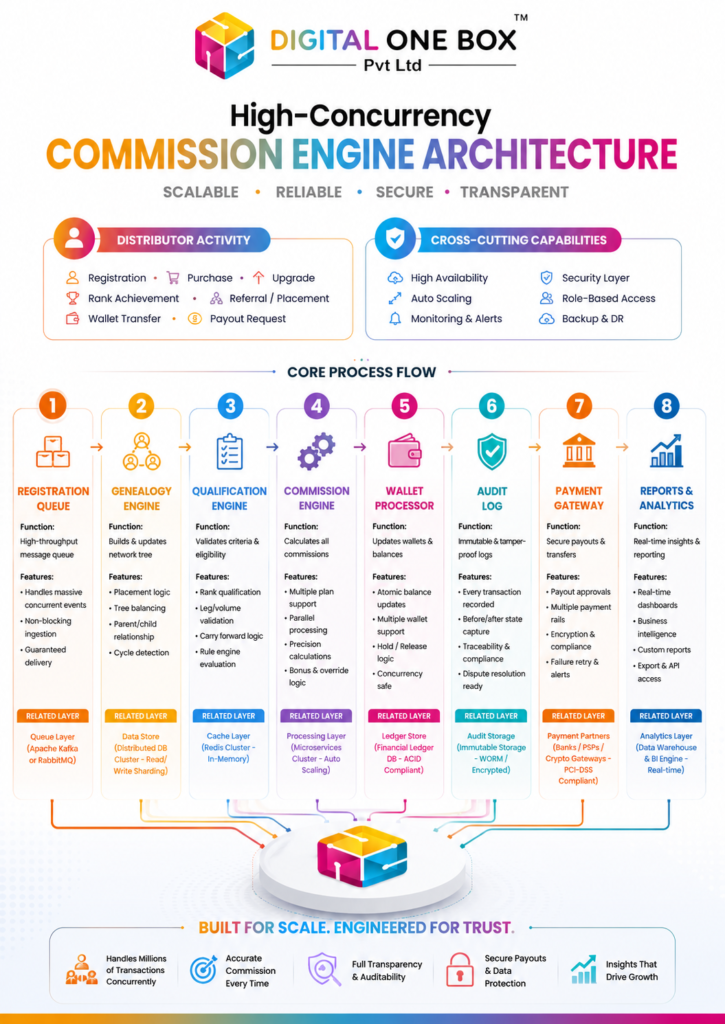
Our engineering team separates:
- Tree processing
- Commission calculations
- Wallet updates
- Notification services
- Reporting
into independent processing layers.
This reduces bottlenecks and allows horizontal scaling without rewriting the entire platform.
What to Ask Your Vendor
- How many concurrent commission calculations has your system processed?
- Do you support distributed processing?
- What happens if one commission batch fails midway?
- Can calculations resume without duplication?
If they cannot explain this architecture clearly, they probably haven’t built it.
Compensation Plan Flexibility
Common Myth
“We only need Binary today.”
Reality
Business models evolve.
Successful MLM companies frequently introduce:
- New bonus structures
- Seasonal incentives
- Leadership rewards
- Promotional campaigns
- Custom regional commissions
If your software has hard-coded logic, every business change becomes a software redevelopment project.
That means:
- More cost
- More bugs
- More downtime
Digital One Box Insight
Our engineering philosophy avoids hard-coded compensation logic whenever possible.
Instead, we build modular commission engines where individual bonus modules can be modified independently.
This allows businesses to introduce new rewards without rebuilding their entire compensation system.
For rapidly growing MLM businesses, this flexibility becomes a competitive advantage rather than just a technical feature.
Signs of a Flexible System
- ✔ Configurable bonus rules
- ✔ Version-controlled commission logic
- ✔ Independent bonus modules
- ✔ Rule-based calculations
- ✔ Expandable architecture
Data Integrity & Audit Trails
Common Myth
“If something goes wrong, we’ll check the database.”
Reality
Financial software cannot rely on manual database investigation.
Every commission must be fully traceable.
Every wallet update must be explainable.
Every adjustment must leave an audit trail.
Without detailed logs, commission disputes become impossible to resolve objectively.
Digital One Box Insight
One migration project involved historical commission mismatches that had accumulated over several payout cycles.
The original software stored only the final commission values—not the calculation path.
As a result, no one could determine where discrepancies originated.
When rebuilding the platform, we implemented a complete commission audit layer that recorded:
- Source transaction
- Qualification status
- Triggered bonus
- Previous wallet balance
- Updated wallet balance
- Timestamp
- Processing node
This dramatically reduced manual support efforts because finance teams could independently verify every payout.
Questions Worth Asking
Can your software answer:
- Why was this bonus generated?
- Why wasn’t this bonus generated?
- Which rule triggered this payout?
- Who modified this commission rule?
- When was it changed?
If not, expect operational headaches.
Security, Compliance & Fraud Prevention
Common Myth
“Our platform uses SSL, so we’re secure.”
Reality
SSL only encrypts communication.
It doesn’t protect your business from:
- Fake account creation
- Wallet manipulation
- Commission abuse
- Referral fraud
- Insider privilege misuse
- Data leaks
MLM platforms manage sensitive financial information.
That demands enterprise-level security.
Essential Security Features
- Role-based permissions
- Multi-factor authentication
- API authentication
- Encryption at rest
- Secure wallet architecture
- Fraud detection
- Activity monitoring
- Login anomaly detection
- Backup automation
Compliance Matters
Depending on your region, your platform may also require alignment with:
- PCI-DSS payment standards
- GDPR privacy requirements
- Local financial regulations
- Tax reporting obligations
Ignoring compliance during development often creates legal complications after launch.
Digital One Box Insight
Fraud prevention should begin at the architecture level—not after fraud occurs.
For example, we design systems that detect suspicious behaviors such as:
- Multiple registrations from identical devices
- Rapid wallet transfers
- Circular referral patterns
- Abnormal commission spikes
- Duplicate KYC attempts
These checks significantly reduce abuse before payouts are processed.
Long-Term Ownership & Vendor Independence
Common Myth
“The development company will always maintain the platform.”
Reality
- Businesses change vendors.
- Internal teams grow.
- Technology evolves.
- You should never become permanently dependent on a single software provider.
Before Signing Any Contract, Ask
- Who owns the source code?
- Can we host the application ourselves?
- Can another developer maintain the platform?
- Is documentation included?
- Are APIs documented?
- Can data be exported?
- Is database structure documented?
Digital One Box Insight
We’ve assisted companies migrating away from legacy MLM systems where critical business logic existed only inside undocumented code.
Simple feature updates required weeks of reverse engineering.
Our documentation process includes:
- API documentation
- Database architecture
- Deployment guides
- Admin workflows
- Commission engine documentation
Because software ownership should belong to the client—not the vendor.
The 5-Question Technical Litmus Test Every Founder Should Use
Before hiring any MLM software development company, ask these five questions.
If they answer confidently—and technically—you’ve likely found an experienced team.
1. How does your commission engine handle back-dated transactions without corrupting historical payouts?
This reveals whether the vendor understands financial ledger integrity.
2. How are genealogy updates processed during high traffic?
Experienced teams will discuss queues, transactions, or asynchronous processing.
Generic agencies won’t.
3. What happens if payout processing stops halfway through?
You’re looking for:
- rollback mechanisms
- retry strategies
- idempotent processing
- recovery architecture
4. Can we introduce a completely new bonus without modifying existing commission logic?
Flexible systems answer yes.
Rigid systems require redevelopment.
5. If we decide to move to another vendor in three years, what do we receive?
A trustworthy partner should provide:
- source code
- documentation
- APIs
- database schema
- deployment instructions
without hesitation.
A Real Engineering Challenge We Solved
One client approached us after experiencing payout processing delays that extended beyond eight hours during monthly commission runs.
The bottleneck wasn’t server hardware.
It was architectural.
Every bonus calculation executed sequentially, locking shared database resources and delaying dependent operations.
Our engineering team redesigned the commission processing workflow by introducing isolated processing layers, optimized database queries, and parallel execution for independent bonus calculations.
The result:
- Faster commission execution
- Reduced database contention
- Improved reporting performance
- Significantly shorter payout windows
- Better scalability for future distributor growth
The biggest lesson?
Performance improvements often come from architecture—not simply adding larger servers.
High-Concurrency Commission Engine Architecture
Why Businesses Choose Digital One Box
Building MLM software requires expertise across multiple engineering disciplines:
- Financial transaction systems
- Database optimization
- Blockchain integration
- Secure wallet development
- API architecture
- Cloud infrastructure
- High-concurrency backend engineering
At Digital One Box, our teams combine these capabilities to create scalable MLM ecosystems designed for long-term growth rather than short-term deployment.
Whether you’re launching a new MLM business or replacing an aging platform, our focus remains the same:
Deliver software that stays reliable as your network expands.
Conclusion
Choosing an MLM software development company shouldn’t be based solely on pricing, design, or portfolio screenshots.
The real evaluation happens beneath the interface.
Ask how they manage concurrency.
Ask how they recover from failures.
Ask how they document their systems.
Ask how they protect your data.
Most importantly, ask how they plan for your business five years from now—not just launch day.
Because when your distributor network grows from hundreds to hundreds of thousands, architecture becomes your greatest competitive advantage.
The right technology partner won’t just build your software.
They’ll build the operational foundation your business depends on.
Author: Lead Solutions Architect, Digital One Box
With extensive experience designing blockchain platforms, fintech solutions, and enterprise MLM software, our architecture team specializes in building secure, scalable commission engines capable of supporting high-growth direct selling businesses. Their work focuses on distributed systems, transaction integrity, cloud infrastructure, and performance optimization for financial applications.