

Multi-level marketing infrastructure is being rebuilt on-chain — and the companies that get the architecture right are leaving legacy MLM platforms permanently behind. This is the technical blueprint for doing MLM smart contract development correctly: from matrix data structures and gas-efficient Solidity patterns to state machine integrity and security-layer hardening.
What is a Smart Contract MLM?
| A smart contract MLM is a decentralized multi-level marketing system engineered entirely through self-executing code on a blockchain network. It automates user registrations, matrix referral tracking, and reward distributions via transparent, peer-to-peer protocols — completely removing the need for a centralized intermediary or human administrator. |
That single architectural shift — from a centralized server to an immutable on-chain protocol — has cascading consequences for trust, payout speed, audit transparency, and long-term platform resilience. Here is what it means technically:
- No Central Database: All participant records, upline relationships, and payout histories are stored on a public distributed ledger. No database administrator can edit, delete, or roll back a transaction.
- Self-Executing Compensation Logic: Reward distributions fire automatically the moment a qualifying network event occurs — a new registration, a matrix fill, or a cycle completion — without requiring a human to approve or process a payout.
- Transparent Referral Tracking: Every upline-downline relationship is mapped on-chain through Solidity mappings and arrays. Anyone can verify the structure using block explorers like Etherscan or Solscan in real time.
- Permissionless Entry and Exit: Participants interact directly with the contract using non-custodial wallets (MetaMask, Trust Wallet). The platform operator never holds user funds in a hot wallet pool.
- Deterministic Execution: Given the same inputs and the same blockchain state, the contract will always produce the same outputs. There is no server-side black box where calculations can be manipulated.
This is not a conceptual upgrade — it is a fundamental replacement of the trust layer. Legacy MLM platforms ask participants to trust the company. A smart contract MLM asks participants to verify the code.
Traditional MLM Software vs. Decentralized Smart Contracts
The gap between legacy MLM platforms and on-chain alternatives is not a feature gap — it is an architectural gap. Vendors like Infinite MLM, Epixel, and Webcom Systems are built on relational database stacks and centralized application servers that were never designed for trustless, permissionless operation. The table below maps the architectural divergence across the metrics that matter most to technical founders and compliance-focused operators.
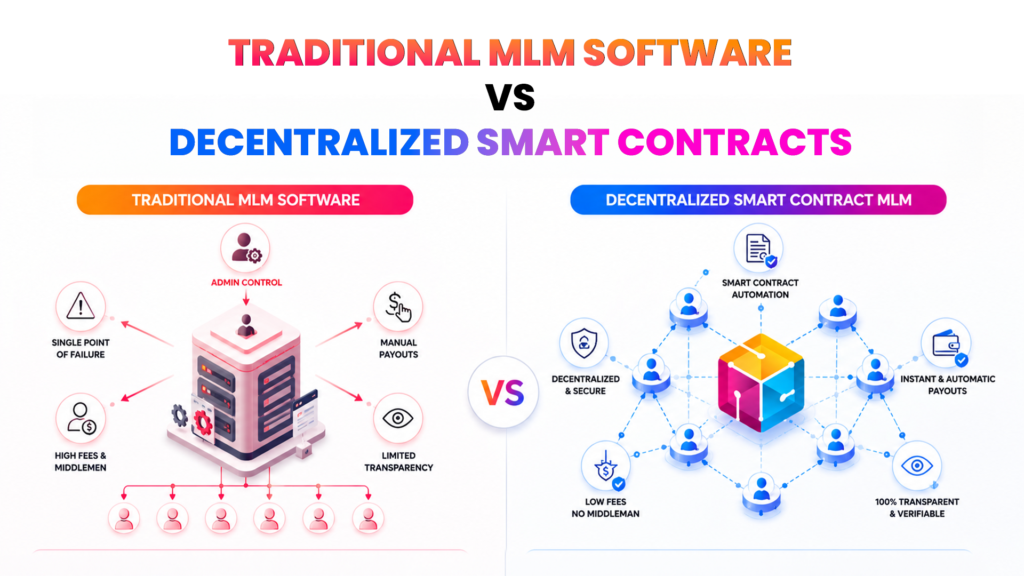
| Architectural Metric | ⚠ Traditional Legacy MLM Software | ✓ Decentralized Smart Contract MLM |
| Data Immutability | RISK — Centralized SQL/NoSQL database. Compensation records are editable by any privileged database administrator. No cryptographic audit trail. | VERIFIED — Cryptographically secured on-chain ledger. Historical compensation records are immutable and permanently auditable by any participant. |
| Payout Mechanics | DELAYED — Batched processing cycles with mandatory administrative approval windows. Manual withdrawal requests introduce 24–72 hour settlement delays. | INSTANT — Automated peer-to-peer execution fires directly to participant wallets upon event completion. No approval queue. No intermediary. |
| Uptime & Reliability | FRAGILE — Single point of failure. Vulnerable to DDoS attacks, server outages, and database corruption events that can freeze an entire network. | RESILIENT — Deployed across a distributed node network. No single server to attack. EVM-compatible chains operate with effectively 100% uptime. |
| Compensation Auditing | OPAQUE — Closed-source business logic. Participants must trust the platform operator’s calculations with zero ability to independently verify correctness. | TRANSPARENT — Open-source contract code. Any participant or auditor can verify payout formulas, referral rules, and matrix logic directly on-chain. |
| Security Posture | CUSTODIAL — Platform holds user funds in pooled wallets. A single backend breach can expose the entire treasury. | NON-CUSTODIAL — Funds flow directly between wallets via contract logic. The platform never holds participant assets in a centralized pool. |
For operators building a network they intend to scale internationally, the compliance implications alone make on-chain architecture the only defensible choice. Regulators in multiple jurisdictions increasingly require demonstrable audit trails — and a public blockchain provides the most tamper-proof trail available.
Technical Blueprint for a Scalable MLM Architecture
This is where most Web3 generalist agencies fall short. Writing a smart contract that works in a test environment is straightforward. Writing one that handles ten thousand concurrent nodes, variable matrix depths, and real-money payout routing under gas constraints is an entirely different engineering problem. The sections below document the critical design decisions that separate production-grade MLM contracts from prototype-level code.
Matrix Data Structure Models
The referral matrix is the core data structure of any MLM smart contract. The choice of matrix type — binary, unilevel, forced matrix, or board/cycle — determines both the Solidity data model and the gas cost profile of every registration event.
- Binary Matrix (2×∞): Each node holds exactly two children. Implemented in Solidity using a mapping(address => address[2]) pattern. Placement logic must traverse the tree breadth-first to locate the first available slot — an O(n) operation that must be gas-bounded with explicit depth limits.
- Forced Matrix (e.g., 3×9): Fixed width and depth. Implemented using a mapping(uint256 => address[]) keyed by matrix level. Completion events (cycle triggers) are emitted as on-chain events for downstream UI consumption.
- Unilevel / Unlimited Width: Each node can have unlimited direct referrals. Stored as a mapping(address => address[]). Payout loops are depth-limited by configuration to prevent gas limit breaches on deep networks.
Code Example — MLMMatrix.sol :
MLMMatrix.sol
// Binary matrix structure with depth-bounded placement
struct Node {
address upline;
address[2] children; // left / right slots
uint32 depth;
uint256 registeredAt;
bool isActive;
}
mapping(address => Node) public matrix;
// Breadth-first search capped at MAX_DEPTH to stay within gas limits
function _findPlacementSlot(
address _root,
uint32 _maxDepth
) internal view returns (address parent, uint8 slot) {
address[] memory queue = new address[](2 ** _maxDepth);
uint256 head = 0;
uint256 tail = 0;
queue[tail++] = _root;
while (head < tail) {
address current = queue[head++];
for (uint8 i = 0; i < 2; i++) {
if (matrix[current].children[i] == address(0)) {
return (current, i); // empty slot found
}
queue[tail++] = matrix[current].children[i];
}
}
revert(“Matrix: no available slot within depth limit”);
}
Gas Optimization Strategy
Gas inefficiency is the most common failure mode in production MLM smart contracts — and the most common source of user attrition. When a new participant’s registration triggers a recursive upline payout loop that hits 500,000+ gas units, transaction failure rates spike and platform credibility collapses. The following patterns eliminate this at the architecture level.
- Pack State Variables: Solidity stores variables in 32-byte slots. Packing uint 32 depth, uint 8 level, and bool is Active into a single slot — rather than three separate uint256 fields — reduces cold storage reads by up to 60% in deeply nested operations.
- Depth-Cap All Loops: Every upline traversal loop must have an explicit uint8 maxDepth parameter enforced at the Solidity level — not just documented. Unbounded loops on large networks will hit the block gas limit and revert the entire transaction.
- Events Over Storage: Historical payout records should be emitted as indexed on-chain events (emit PaidUpline(from, to, amount, level)) rather than written to persistent storage arrays. Reading events from a node is free; writing to storage costs 20,000 gas per new slot.
- Proxy Pattern for Upgradability: Deploy the core logic behind an EIP-1967 transparent proxy. This allows gas-cost-reducing optimizations and bug fixes to be pushed post-launch without requiring users to re-register on a new contract address.
| ⚠ Common Pitfall: Generic Web3 agencies frequently ship MLM contracts where a matrix fill event at level 8+ triggers a gas cost exceeding 2.4M units — more than the Ethereum mainnet block gas limit. The breadth-first placement pattern shown above, combined with depth-capped payout loops, keeps registration costs predictable at every matrix depth. |
Code Example — GasOptimized.sol:
GasOptimized.sol
// Packed struct: all 4 fields fit in a single 32-byte storage slot
struct PackedUser {
address upline; // 20 bytes
uint32 registeredAt; // 4 bytes — unix timestamp
uint8 level; // 1 byte — matrix level
bool isActive; // 1 byte
// 6 bytes padding — compiler fills slot cleanly
}
// Emit-only payout log — zero storage cost
event PaidUpline(
address indexed from,
address indexed to,
uint256 amount,
uint8 level
);
function _distributeUpline(
address _from,
uint256 _amount,
uint8 _maxLevels
) internal {
address cursor = users[_from].upline;
for (uint8 i = 0; i < _maxLevels && cursor != address(0); i++) {
uint256 share = (_amount * levelPercent[i]) / 10000;
(bool ok, ) = cursor.call{value: share}(“”);
require(ok, “Transfer failed”);
emit PaidUpline(_from, cursor, share, i);
cursor = users[cursor].upline;
}
}
State Machine Integrity
A production MLM smart contract is fundamentally a state machine. Every registration is a state transition — and the exact sequence of operations within that transition must be enforced at the code level, not assumed. The five-step sequence below is the correct order of operations for a new participant registration:
- Step 1 — Input Validation: Assert that the registering address is not already active, that the payment value matches the current plan fee, and that the provided referral address is a registered, active participant.
- Step 2 — Upline Resolution: If no referral is provided or the provided referral’s matrix is full, the contract automatically routes the new user to the platform root or the next available auto-placement slot.
- Step 3 — State Write: Write the new PackedUser struct to the mapping(address => PackedUser). Update the parent node’s children array to reference the new address.
- Step 4 — Fund Distribution: Execute the upline payout loop. All ETH/BNB/MATIC transfers happen after state is written — this is the check-effects-interactions pattern that prevents reentrancy exploits.
- Step 5 — Event Emission: Emit UserRegistered, PaidUpline, and — if applicable — MatrixCycleCompleted events for off-chain indexing and front-end reactivity.
| ℹ Explore full-service blockchain development for a complete breakdown of deployment chains (BNB Chain, Polygon, Tron, Ethereum) and their respective trade-offs for MLM workloads. See: digitalonebox.com/blockchain-development-services |
Critical Security Layers in Decentralized MLM Frameworks
Security in a production MLM smart contract is non-negotiable — not because of regulatory expectation, but because a single exploit in a live network can drain the entire treasury in one transaction. The exploits below are the three highest-priority vectors in MLM-specific contracts. Each has a well-defined countermeasure that must be implemented before testnet deployment, not patched in after a mainnet incident.

Reentrancy Protection
A reentrancy attack occurs when an external contract — typically a malicious wallet controlled by an attacker — recursively calls back into the target contract during an active ETH transfer, re-entering the payout function before the state has been updated. In an MLM context, this allows an attacker to drain the contract’s balance repeatedly within a single transaction.
There are two enforced countermeasures — implement both:
- Check-Effects-Interactions (CEI) Pattern: Always update all state variables — user balances, active flags, matrix position — before executing any external calls or ETH transfers. The code block demonstrates this pattern correctly: the PackedUser struct is written before _distributeUpline is called.
- OpenZeppelin ReentrancyGuard: Inherit from ReentrancyGuard and apply the nonReentrant modifier to every payable external function. This introduces a mutex lock that reverts any re-entry attempt at the EVM level, regardless of the call stack depth.
Code Example — SecureMLM.sol :
SecureMLM.sol
import “@openzeppelin/contracts/security/ReentrancyGuard.sol”;
import “@openzeppelin/contracts/access/Ownable.sol”;
contract SecureMLM is ReentrancyGuard, Ownable {
// nonReentrant mutex prevents recursive call exploitation
function register(address _referral)
external
payable
nonReentrant // <- OpenZeppelin mutex lock
{
// 1. CHECKS
require(!users[msg.sender].isActive, “Already registered”);
require(msg.value == registrationFee, “Incorrect fee”);
require(users[_referral].isActive, “Invalid referral”);
// 2. EFFECTS — state written BEFORE any transfer
users[msg.sender] = PackedUser({
upline: _referral,
registeredAt: uint32(block.timestamp),
level: 1,
isActive: true
});
// 3. INTERACTIONS — external calls happen last
_distributeUpline(msg.sender, msg.value, MAX_LEVELS);
emit UserRegistered(msg.sender, _referral, block.timestamp);
}
}
Integer Overflow Management
MLM networks can accumulate reward pools in the billions of token units — especially on BNB Chain where popular networks process tens of thousands of daily registrations. Unchecked arithmetic on pre-0.8.x Solidity compilers would silently wrap these large values, corrupting payout calculations without reverting the transaction.
- Solidity 0.8.x+ (Recommended): All arithmetic operations in Solidity 0.8.0 and later include built-in overflow and underflow checks. Any operation that would exceed the type’s maximum value — type(uint256).max — reverts automatically. There is no additional code required.
- SafeMath for Legacy Contracts: If you are auditing or upgrading a contract compiled against Solidity <0.8.0, apply OpenZeppelin’s SafeMath library to every arithmetic operation involving payout calculations, balance tracking, or user counters.
- Percentage Arithmetic Precision: Use basis points (1/10,000) instead of percentages (1/100) for reward calculations. (amount * 150) / 10000 (1.5%) prevents integer truncation errors that silently reduce payout amounts on small denomination transactions.
Rigorous Code Verification Pipelines
No smart contract should reach a public testnet without passing a structured, automated verification pipeline. The following pipeline is the minimum viable process for a production MLM contract deployment. Each stage runs in isolation, and a failure at any stage blocks promotion to the next environment.
- Stage 1 — Unit Testing (Hardhat / Foundry): Every function is tested in isolation with explicit coverage targets for happy-path, edge-case, and revert scenarios. Foundry’s forge coverage report must show ≥95% line coverage before promotion.
- Stage 2 — Fuzzing (Foundry Invariant Tests): Foundry’s fuzzer generates thousands of random input combinations targeting the registration, placement, and payout functions. Invariant tests assert that the total distributed value never exceeds the contract’s received balance.
- Stage 3 — Static Analysis (Slither): Trail of Bits’ Slither scanner runs against the compiled ABI to detect known vulnerability patterns — reentrancy, unprotected selfdestruct, integer overflow, and unchecked low-level calls — before a human auditor reviews the code.
- Stage 4 — Containerized Testnet Deployment: The contract is deployed to a forked mainnet environment (Hardhat Network with forking.enabled: true) to simulate real-world gas conditions and token interactions without risk.
- Stage 5 — Third-Party Security Audit: An independent audit firm reviews the codebase and delivers a public audit report. Digital One Box partners with recognized auditors and publishes audit reports on the project’s documentation hub.
| ℹ Digital One Box’s smart contract audit service runs all five stages and delivers a full vulnerability report with remediation steps before any mainnet deployment. See: digitalonebox.com/smart-contract-audit |
Ready to Build Your MLM Smart Contract?
Digital One Box engineers production-grade MLM smart contract systems — from matrix architecture and gas optimization to security audits and mainnet deployment. No generic templates. No offshore resell. Pure engineering.
Contact: https://www.digitalonebox.com/contact-us
Service Page: https://www.digitalonebox.com/mlm-smart-contract-development/
Related Resources
MLM Smart Contract Development — Full Service Overview: https://digitalonebox.com/
Blockchain Development Services — EVM, Solana & Beyond: https://digitalonebox.com/blockchain-development
Smart Contract Audit — 5-Stage Security Verification Pipeline: digitalonebox.com/smart-contract-audit/
Web3 Development — DApps, DeFi Protocols & On-Chain Tooling: digitalonebox.com/web3-development/
Production Deployments — Audited MLM Contracts in Live Networks: https://digitalonebox.com/portfolio
Technical Blog — Blockchain Architecture & Web3 Engineering: https://blog.digitalonebox.com/