
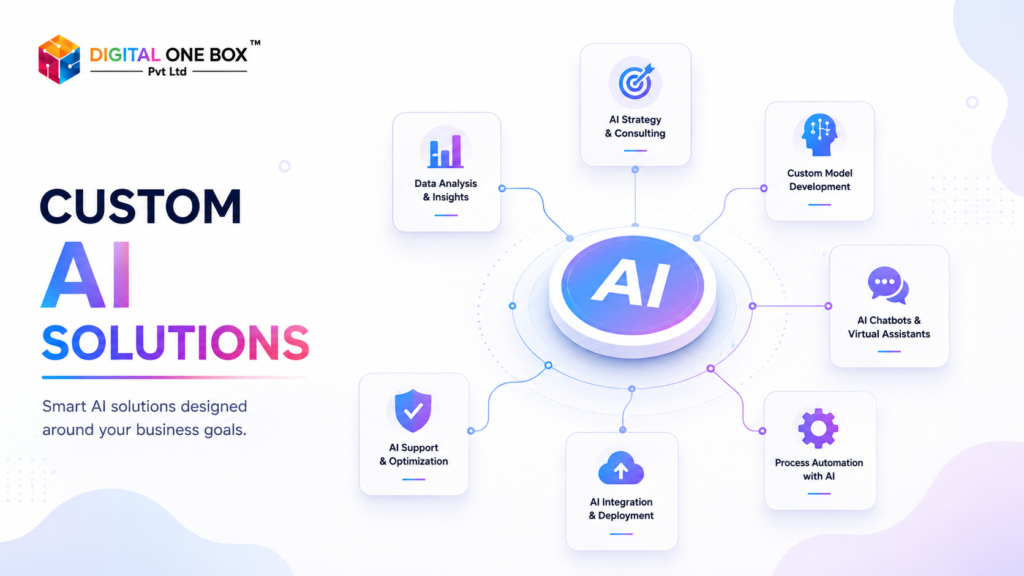
Artificial Intelligence has moved beyond experimental projects, with global spending on AI systems projected to grow significantly as businesses prioritize intelligent automation (IDC). Businesses are now using AI to automate workflows, analyze data, personalize customer experiences, generate content, and build intelligent digital products (Source: Forbes).
Tools such as ChatGPT have made AI accessible, but businesses often need more than a general-purpose AI tool. They need AI that understands their business data, workflows, applications, customers, and industry requirements.
This is where custom AI solutions become valuable.
A custom AI solution is designed around a specific business objective rather than providing the same functionality to every user. It can integrate proprietary data, enterprise systems, APIs, workflows, and specialized AI models to create a solution tailored to an organization’s needs.
In this guide, we’ll explore custom AI development, use cases, technology, benefits, costs, and how businesses can determine whether custom AI is the right approach.
What Are Custom AI Solutions?
Custom AI solutions are artificial intelligence applications designed and developed for a specific business, product, workflow, or industry requirement.
Instead of relying entirely on an off-the-shelf AI platform, businesses can create AI systems that work with their own data and technology ecosystem.
A custom AI solution may combine:
- Large Language Models (LLMs)
- Machine Learning
- Generative AI
- Retrieval-Augmented Generation (RAG)
- AI Agents
- Computer Vision
- Natural Language Processing
- APIs and enterprise software
- Cloud infrastructure
- Databases and knowledge bases
For example, a company could develop an AI agent that understands internal documentation, retrieves information from a knowledge base, accesses a CRM, and automatically completes specific business workflows.
Custom AI vs Off-the-Shelf AI
One of the most important decisions businesses face is whether to use an existing AI product or build a custom solution.
| Off-the-Shelf AI | Custom AI |
| General-purpose functionality | Business-specific functionality |
| Limited customization | Highly customizable |
| Generic knowledge | Proprietary business data |
| Standard workflows | Custom workflows |
| Predefined integrations | Custom integrations |
| Faster initial deployment | Greater long-term flexibility |
| Limited control | Greater control over architecture |
Off-the-shelf AI tools can be useful for everyday productivity. However, custom AI becomes more attractive when a business needs specialized functionality, proprietary data, complex integrations, or automated workflows.
The objective isn’t always to replace existing AI tools. In many cases, businesses can integrate existing foundation models into a custom AI application.
Why Businesses Need Custom AI Solutions in 2026
The AI market is moving from simple content generation toward intelligent applications, AI agents, automation, and enterprise integration.
Businesses are investing in custom AI to achieve several goals.
Business-Specific Intelligence
Generic AI doesn’t always understand a company’s internal terminology, processes, products, or policies.
Custom AI can connect models to proprietary knowledge and business data.
Workflow Automation
AI can move beyond answering questions and help execute multi-step processes.
For example:
Customer request → AI analysis → Data retrieval → Decision → System update → Notification
Enterprise Integration
Custom AI can connect with CRM, ERP, databases, payment systems, internal applications, APIs, and cloud infrastructure.
Personalization
AI applications can use customer information and behavioral data to deliver personalized recommendations and experiences.
Scalability
A custom architecture can be designed around expected users, workloads, security requirements, and future functionality.
Top Custom AI Solutions & Business Use Cases
AI Agent Development
AI agents are becoming one of the most important areas of AI development.
Unlike traditional chatbots, AI agents can be designed to perform multi-step tasks, use tools, retrieve information, interact with applications, and execute workflows.
Businesses can use AI agents for:
- Customer support
- Sales qualification
- Research
- Data analysis
- Internal operations
- Document processing
- Workflow automation
Digital One Box provides AI Agent Development for businesses looking to build intelligent systems around specific workflows and applications.
AI Chatbot Development
Custom AI chatbots can provide more than predefined responses.
By combining LLMs with RAG, business knowledge bases, APIs, and application data, companies can create conversational systems capable of answering context-specific questions.
Common applications include:
- Customer support
- Sales assistance
- Employee helpdesks
- Product support
- Knowledge management
AI Workflow Automation
Many businesses still rely on repetitive manual processes.
Custom AI can automate workflows involving documents, customer requests, data analysis, reporting, and internal operations.
For example:
Email → AI classification → Information extraction → Business rule → CRM update → Automated response
This can reduce repetitive work while allowing employees to focus on higher-value activities.
Generative AI Applications
Generative AI can create text, images, code, summaries, reports, and other content.
Custom Generative AI solutions can be designed for:
- Marketing
- Content production
- Document analysis
- Software development
- Knowledge management
- Product recommendations
- Customer experiences
Instead of giving employees access to a generic AI tool, businesses can build AI directly into the applications and workflows they already use.
AI + Web3 Solutions
AI and Web3 can complement each other by combining intelligent decision-making with decentralized infrastructure.
Potential applications include:
- Intelligent DApps
- AI-powered Web3 platforms
- Autonomous Web3 workflows
- Decentralized AI applications
- Intelligent blockchain analytics
For businesses exploring the convergence of AI and decentralized technologies, custom development can provide greater flexibility than isolated AI or Web3 tools.
AI Blockchain Integration
AI can be integrated with blockchain infrastructure for applications involving analytics, automation, security, identity, and decentralized systems.
Potential use cases include:
- Transaction analysis
- Fraud detection
- Blockchain monitoring
- Smart-contract-related automation
- Decentralized identity
- Risk analysis
This is particularly relevant for organizations building enterprise Web3 products.
AI-Powered DApps
AI-powered decentralized applications combine intelligent functionality with blockchain-based infrastructure.
AI can provide:
- Recommendations
- Predictive analytics
- Automated workflows
- Natural-language interfaces
- Intelligent decision support
This creates opportunities for a new generation of decentralized applications that go beyond traditional blockchain functionality.
AI Trading Bot Development
AI can also be incorporated into trading systems for market analysis, signal generation, strategy automation, and risk-management workflows.
Custom AI trading systems may combine:
- Market data
- Machine Learning
- Predictive models
- Technical indicators
- Automated strategies
- Risk controls
The architecture should prioritize security, testing, monitoring, and responsible deployment.
Custom AI Development Technology Stack
The technology stack depends on the project’s requirements.
AI & Machine Learning
- Machine Learning
- Deep Learning
- NLP
- Generative AI
- LLMs
- Computer Vision
AI Architecture
- RAG
- Vector databases
- Knowledge bases
- AI agents
- Model APIs
- AI orchestration
Application Development
- Python
- JavaScript / TypeScript
- React
- Node.js
- REST APIs
Infrastructure
- Cloud platforms
- Databases
- Data pipelines
- Authentication
- Monitoring
- Security systems
The right stack should be selected according to the business problem, rather than choosing technologies simply because they are currently popular.
How Much Do Custom AI Solutions Cost in 2026?
There is no fixed price for custom AI development.
The investment depends on:
- Application complexity
- Number of AI features
- Model selection
- Data requirements
- RAG or fine-tuning
- AI agent complexity
- Number of integrations
- User interface requirements
- Security
- Cloud infrastructure
- Scalability
- Maintenance
A simple AI-powered feature may require significantly less development than an enterprise platform containing AI agents, private data infrastructure, multiple APIs, advanced security, and continuous monitoring.
The best way to estimate the cost is to define the MVP scope and technical architecture first.
Custom AI Development Process
A structured process can reduce development risks and keep the project focused.
1. Discover
Identify the business problem, users, workflows, data, and expected outcomes.
2. Design
Define the AI architecture, technology stack, integrations, user experience, and security requirements.
3. Develop
Build the AI models or integrations, backend services, interfaces, workflows, and supporting infrastructure.
4. Integrate
Connect the AI system with databases, APIs, CRM, ERP, blockchain networks, or other business applications.
5. Test
Evaluate accuracy, reliability, security, performance, and user experience.
6. Deploy & Optimize
Deploy the solution and continuously monitor performance, usage, costs, and AI quality.
When Should You Choose Custom AI?
Custom AI is worth considering when:
- Your business has proprietary data.
- Generic AI doesn’t understand your workflows.
- You require specialized AI functionality.
- Multiple business systems need to be connected.
- You want AI agents to perform tasks.
- You require greater control over data and security.
- AI is becoming a core part of your product.
- You need a solution that can scale with your organization.
If the requirement is simply generating an occasional email or summarizing a document, an off-the-shelf tool may be sufficient.
The goal of custom AI should be to solve a specific business problem better, not to build AI simply for the sake of using AI.
Why Choose Digital One Box for Custom AI Solutions?
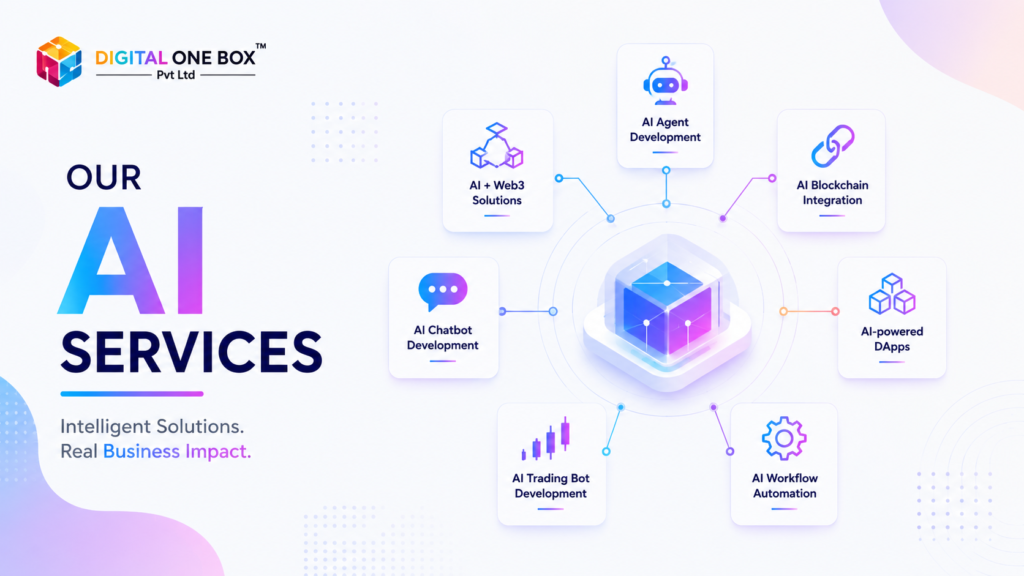
At Digital One Box, we design and develop AI solutions around business requirements, workflows, data, and technology ecosystems.
Our AI capabilities include:
- AI Agent Development
- AI + Web3 Solutions
- AI Blockchain Integration
- AI Chatbot Development
- AI-powered DApps
- AI Trading Bot Development
- AI Workflow Automation
From intelligent agents and conversational applications to AI-powered Web3 products and enterprise automation, our approach focuses on building solutions that can integrate with real business environments.
Whether you’re validating an AI product idea or transforming an existing enterprise workflow, Digital One Box can help define the architecture, develop the solution, integrate AI into your technology stack, and prepare it for scalable deployment
Conclusion
Custom AI solutions are becoming an important way for businesses to move beyond generic AI tools and build intelligence directly into their products, workflows, and operations.
The strongest opportunities in 2026 are not limited to Generative AI. AI agents, workflow automation, enterprise AI, RAG, intelligent applications, and AI-powered Web3 solutions are expanding the role of artificial intelligence across industries.
The right approach is to start with a measurable business problem, identify where AI can create the greatest value, build a focused MVP, and then scale the solution as results are validated.
With capabilities spanning AI Agent Development, AI Chatbot Development, AI Workflow Automation, AI + Web3, AI Blockchain Integration, AI-powered DApps, and AI Trading Bot Development, Digital One Box helps businesses turn AI opportunities into customized, production-ready digital solutions.
Frequently Asked Questions
What are custom AI solutions?
Custom AI solutions are AI-powered applications designed around a specific company’s data, workflows, business requirements, and technology environment.
What is the difference between custom AI and ChatGPT?
ChatGPT is a general-purpose AI product, while a custom AI solution can be built around a company’s proprietary data, workflows, applications, APIs, and specific business requirements.
How much does custom AI development cost?
Custom AI development costs vary according to functionality, AI models, data, integrations, security, infrastructure, and project complexity. An MVP can provide a more accurate basis for estimating the overall investment.
How long does custom AI development take?
Development time depends on the scope and complexity of the solution. A focused AI feature can be developed faster than an enterprise AI platform requiring multiple integrations, custom workflows, and advanced security.
What businesses can benefit from custom AI?
Almost any industry can benefit when AI addresses a specific high-value problem, including healthcare, finance, retail, manufacturing, logistics, software, Web3, and professional services.