
Artificial Intelligence is moving rapidly from experimentation to real-world business applications. Companies are investing in AI-powered software, Generative AI, Machine Learning, AI chatbots, autonomous AI agents, and workflow automation to improve productivity and create new digital products.
The popularity of tools such as ChatGPT and Chat GPT has made artificial intelligence accessible to millions of users. At the same time, businesses are moving beyond ready-made AI tools and investing in customized solutions designed around their data, workflows, customers, and industry requirements.
This raises an important question: How much does AI development cost in 2026?
There is no single price. The cost depends on the application’s complexity, AI model, data requirements, integrations, security, infrastructure, and development scope.
This guide explains the major factors affecting AI development cost, from AI applications and chatbots to AI agents and enterprise solutions.
What Is AI Development?
AI development is the process of designing, building, integrating, deploying, and maintaining software that uses artificial intelligence to perform tasks that traditionally require human intelligence.
Modern AI development can involve several technologies, including:
- Machine Learning
- Generative AI
- Natural Language Processing
- Computer Vision
- Large Language Models
- AI Agents
- Retrieval-Augmented Generation (RAG)
- Predictive Analytics
The appropriate technology depends on the business problem.
For example, a company may use Machine Learning for predictive analytics, Generative AI for content creation, or AI agents for multi-step workflow automation.
How Much Does AI Development Cost in 2026?
AI development costs vary significantly depending on the solution being developed.
A basic AI-powered feature can be relatively straightforward when it uses an existing AI API. In contrast, a customized enterprise AI platform may require model customization, RAG, private data infrastructure, complex integrations, security controls, cloud deployment, and continuous monitoring.
Major cost categories include:
- AI app development
- AI software development
- AI chatbot development
- AI agent development
- Generative AI development
- Machine Learning solutions
- Enterprise AI integration
- AI workflow automation
Therefore, businesses should estimate the complete technology architecture, rather than looking at the AI model cost alone.
What Factors Affect AI Development Cost?
1. Type of AI Solution
The first cost factor is the type of application.
An AI chatbot, recommendation engine, AI image generator, autonomous AI agent, and enterprise AI platform all require different architectures.
For example, an AI chatbot may require an LLM, API integration, backend, knowledge base, and interface. An AI agent may additionally need memory, tools, orchestration, permissions, APIs, and workflow automation.
2. AI Models & Technology
Businesses can integrate existing foundation models or develop customized AI models.
Depending on the use case, development may involve:
- Large Language Models
- Generative AI
- Machine Learning
- NLP
- Computer Vision
- RAG
- AI Agents
Tools such as ChatGPT demonstrate how powerful general-purpose AI can be, but enterprise applications often require additional customization, business context, integrations, and security.
3. Data Requirements
AI performance depends heavily on the quality and accessibility of data.
Development costs can increase when a project requires:
- Data collection
- Data cleaning
- Data labeling
- Data pipelines
- Vector databases
- Knowledge bases
- Fine-tuning
- Data governance
For businesses handling sensitive information, privacy, access control, and secure data processing are also essential.
AI App Development Cost
AI app development can range from adding a single AI capability to an existing application to creating a complete AI-powered product.
A basic AI application might use an existing model through an API.
Advanced applications may require:
- Custom AI workflows
- RAG
- AI agents
- User authentication
- APIs
- Cloud infrastructure
- Analytics
- Data pipelines
- Security
- Web and mobile applications
The development cost therefore depends on the features and architecture required.
For example, an application that uses AI to generate text has different requirements from an application combining conversational AI, computer vision, recommendations, and autonomous workflows.
AI Agents & Agentic AI Development
One of the most important developments in AI is the shift from conversational tools toward AI Agents and Agentic AI.
Traditional AI applications generally respond to user instructions. AI agents can be designed to perform multiple steps, use tools, retrieve information, interact with business systems, and execute workflows.
An enterprise AI agent might:
- Understand a request.
- Retrieve relevant business information.
- Decide which tools are required.
- Interact with APIs or databases.
- Complete the workflow.
- Return the result to the user.
This makes AI agent development more complex than a conventional chatbot.
A production-ready agent may require:
- LLM integration
- Agent orchestration
- Memory
- RAG
- Tool calling
- API integrations
- Workflow automation
- Authentication
- Monitoring
- Human approval mechanisms
For Digital One Box, this represents an important area of AI development because intelligent agents can connect directly with enterprise workflows.
Generative AI Development
Generative AI allows applications to create new content such as text, images, code, audio, and video.
Businesses are using Generative AI for:
- Marketing content
- Product descriptions
- Customer support
- Software development
- Document analysis
- Knowledge management
- Personalized recommendations
- Content generation
AI image generators are another example of Generative AI, enabling users to create visual assets from natural-language instructions.
However, enterprise Generative AI requires more than connecting an application to a public model. Businesses often need RAG, private knowledge bases, access controls, evaluation systems, and monitoring to deliver reliable results.
Machine Learning & Enterprise AI
Machine Learning remains an important part of modern AI development.
Businesses can use Machine Learning for:
- Fraud detection
- Demand forecasting
- Predictive maintenance
- Recommendation systems
- Risk analysis
- Customer segmentation
- Anomaly detection
Enterprise AI combines these capabilities with business data, applications, cloud infrastructure, and automation.
This allows organizations to move from isolated AI experiments toward measurable business outcomes.
AI Development Process
A structured AI development lifecycle helps control costs and reduce technical risks.
1. Discovery
Identify the business problem, users, expected outcomes, and measurable KPIs.
2. Architecture
Select the AI models, frameworks, databases, APIs, infrastructure, and security architecture.
3. Development
Build the AI functionality, application interfaces, backend services, integrations, and workflows.
4. Testing
Evaluate accuracy, reliability, security, performance, hallucinations, and user experience.
5. Deployment
Deploy the solution to a suitable cloud or enterprise environment.
6. Monitoring & Optimization
AI applications require continuous evaluation, monitoring, security updates, and performance optimization.
AI Development Use Cases in 2026
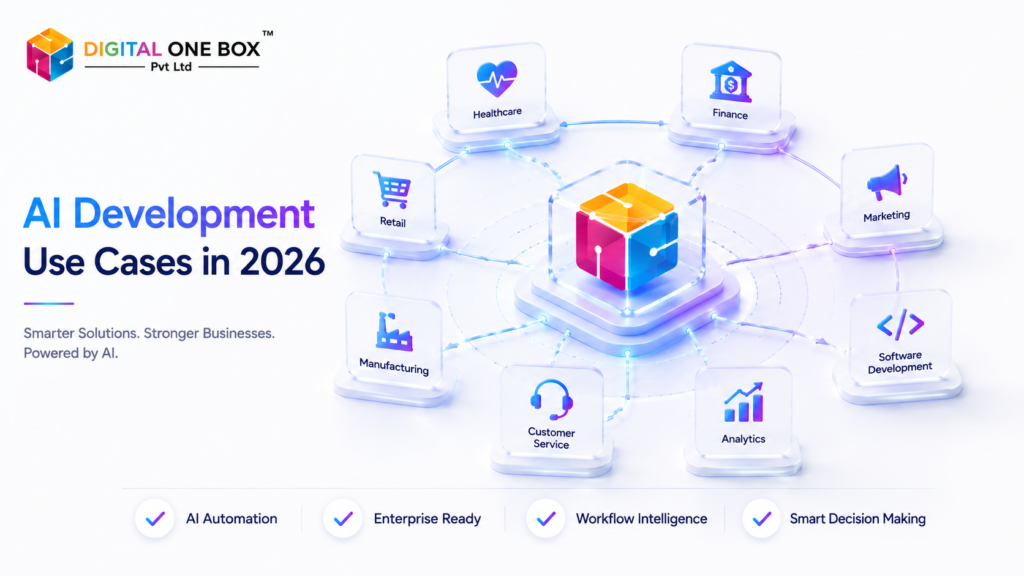
Modern AI development is being applied across industries and technologies.
AI Chatbots
Businesses use conversational AI for customer support, sales, internal knowledge, and service automation.
AI Workflow Automation
AI can automate repetitive business processes such as document processing, reporting, customer requests, and internal operations.
AI Agents
Agentic systems can execute multi-step tasks and interact with enterprise applications.
AI + Web3
AI can enhance decentralized applications with intelligent automation, recommendations, analytics, and autonomous functionality.
AI Blockchain Integration
Combining AI with blockchain can support intelligent transaction analysis, security, decentralized identity, and automated smart-contract-related workflows.
AI-powered DApps
AI can introduce intelligent capabilities into decentralized applications, creating more personalized and automated Web3 experiences.
AI Trading Bots
AI can be incorporated into trading systems for market analysis, strategy automation, signal generation, and risk-management workflows.
Why Choose Digital One Box for AI Development?
At Digital One Box, we build customized AI solutions around specific business objectives rather than applying a one-size-fits-all approach.
Our AI services include:
- AI Agent Development
- AI + Web3 Solutions
- AI Blockchain Integration
- AI Chatbot Development
- AI-powered DApps
- AI Trading Bot Development
- AI Workflow Automation
Our development approach combines AI models, software engineering, data, APIs, cloud infrastructure, and security to create scalable solutions.
Whether you’re developing an intelligent chatbot, autonomous AI agent, AI-powered application, Web3 product, or enterprise automation system, Digital One Box can help transform the concept into a production-ready solution.
Conclusion
The cost of AI development in 2026 depends on much more than selecting an AI model. Data, architecture, integrations, security, infrastructure, customization, and ongoing optimization all influence the overall investment.
The rapid adoption of Artificial Intelligence, Machine Learning, Generative AI, ChatGPT-style applications, and AI Agents is creating new opportunities for businesses to automate operations and build intelligent products.
For organizations looking beyond off-the-shelf AI tools, customized development provides greater control over functionality, data, integrations, and scalability.
Digital One Box brings together AI Agent Development, AI Chatbot Development, AI Workflow Automation, AI + Web3 Solutions, AI Blockchain Integration, AI-powered DApps, and AI Trading Bot Development to help businesses turn emerging AI capabilities into practical digital solutions.
Frequently Asked Questions
How much does AI development cost in 2026?
AI development cost depends on application complexity, AI models, data requirements, integrations, security, infrastructure, and development scope. A simple AI integration generally requires less engineering than a customized enterprise platform.
How much does it cost to build an AI app?
AI app development cost depends on features, platforms, AI capabilities, integrations, backend architecture, and security requirements. A technical discovery process is recommended before providing an accurate estimate.
What is the difference between AI agents and chatbots?
Chatbots primarily communicate with users, while AI agents can be designed to reason through tasks, use tools, access information, interact with systems, and execute multi-step workflows.
What technologies are used in AI development?
Modern AI development can involve LLMs, Generative AI, Machine Learning, RAG, vector databases, APIs, cloud infrastructure, Python, JavaScript, and specialized AI frameworks.
Can AI be integrated with blockchain and Web3?
Yes. AI can be integrated with blockchain and Web3 applications for intelligent automation, analytics, security, personalization, and autonomous decentralized workflows.