
Blockchain has evolved from a technology primarily associated with cryptocurrency into infrastructure for financial services, tokenized assets, supply chains, digital identity, decentralized applications, and enterprise systems.
However, not every business needs to build an entirely new blockchain network. Many organizations need something more specific: a custom blockchain solution designed around their business model, data, security requirements, integrations, and scalability goals.
This is where custom blockchain development becomes valuable.
A custom blockchain solution can include specialized smart contracts, private or permissioned networks, decentralized applications, tokenization infrastructure, enterprise integrations, or even a custom blockchain protocol.
For businesses considering blockchain adoption in 2026, the key question isn’t simply “Can we use blockchain?” It is:
“What blockchain architecture can solve our business problem securely and at scale?”
What Is Custom Blockchain Development?
Custom blockchain development is the process of designing and building blockchain-based software or infrastructure specifically for a company’s requirements.
Instead of adapting a generic blockchain application, developers design the technology around factors such as:
- Business logic
- Consensus requirements
- Transaction volume
- Security
- Privacy
- Smart contracts
- Existing software
- Regulatory requirements
- User experience
- Scalability
A custom solution might be built on an existing network such as Ethereum, Polygon, or Solana, or it could involve a private blockchain or a completely customized blockchain protocol.
The right choice depends on the problem being solved.
Why Businesses Choose Custom Blockchain Solutions
Businesses typically consider custom blockchain development when traditional databases or standard blockchain applications cannot adequately address their requirements.
Greater Control
A custom architecture gives businesses more control over network behavior, permissions, governance, data access, and application logic.
Better Integration
Blockchain can be connected with existing CRM, ERP, payment systems, IoT devices, APIs, and cloud infrastructure.
Scalability
The architecture can be designed around expected transaction volume, users, and future growth rather than adapting an existing system after deployment.
Specialized Business Logic
Smart contracts can automate business rules such as payments, settlements, ownership transfers, verification, and reward distribution.
Enterprise Security
Custom blockchain systems can incorporate permission controls, encryption, key management, monitoring, auditing, and other security mechanisms.
Digital One Box similarly approaches blockchain projects around business requirements, architecture, security, scalability, and long-term product goals, rather than simply selecting a blockchain and starting development. (Digital one box)
Custom Blockchain vs Existing Blockchain Platforms
Building everything from scratch isn’t always the best option.
| Approach | Best For |
| Existing public blockchain | dApps, tokens, DeFi, Web3 applications |
| Layer-2 network | Lower transaction costs and higher scalability |
| Private blockchain | Controlled enterprise environments |
| Permissioned blockchain | Multi-organization business networks |
| Custom blockchain | Specialized infrastructure and unique requirements |
For many products, building on an established network can reduce development complexity. A completely custom chain makes more sense when the business needs control over consensus, governance, performance, privacy, or network economics.
Key Features of a Custom Blockchain
A custom blockchain architecture can include several layers.
Consensus Mechanism
The consensus mechanism determines how transactions are validated and how network participants agree on the blockchain state.
Smart Contracts
Smart contracts automate predefined business logic without requiring manual execution.
Wallet & Identity Layer
Users can securely interact with blockchain applications through wallets, authentication systems, and identity infrastructure.
Permission Management
Enterprise networks may require different access levels for administrators, partners, employees, customers, and validators.
APIs & Integration
Blockchain applications often need APIs connecting on-chain functionality with Web2 systems, databases, payment gateways, and external services.
Monitoring & Security
Production blockchain systems require transaction monitoring, vulnerability testing, key management, smart contract audits, and continuous security controls.
Custom Blockchain Architecture Explained
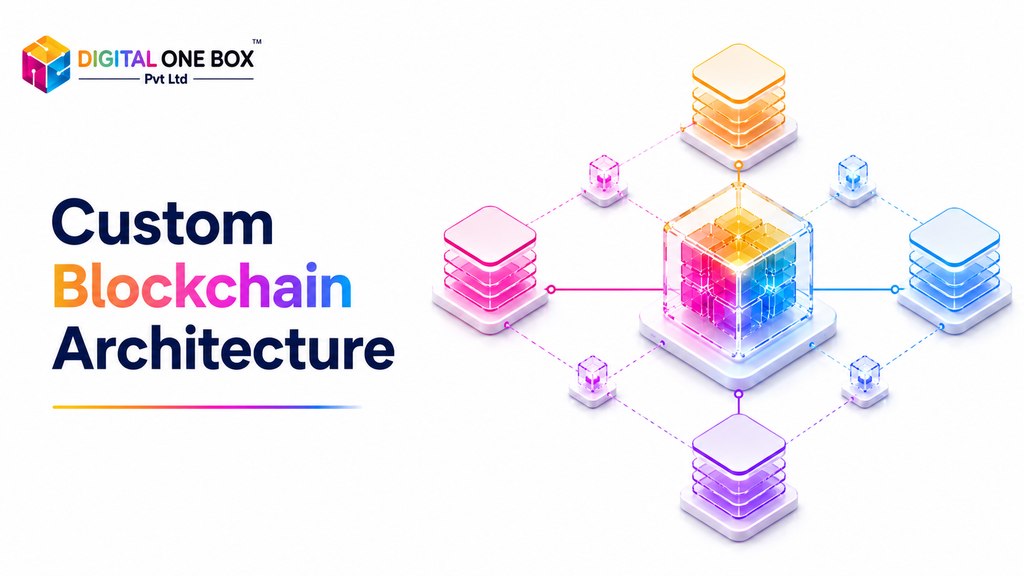
A scalable blockchain solution generally combines several components:
User/Application Layer → API Layer → Smart Contracts → Blockchain Network → Consensus → Data & Storage
The application layer provides the user experience.
The API layer connects blockchain functionality with external systems.
Smart contracts execute business logic.
The blockchain network records transactions and maintains the distributed state.
Consensus validates transactions.
Off-chain databases and storage systems can handle information that doesn’t need to be stored directly on-chain.
This hybrid architecture can improve performance while maintaining blockchain-based verification where it provides the most value.
Digital One Box’s existing blockchain architecture guidance similarly emphasizes scalability, smart contracts, security, cloud infrastructure, APIs, and enterprise integration as important architectural considerations. (Digital one box)
Top Custom Blockchain Development Use Cases
Finance & FinTech
Blockchain can support:
- Cross-border payments
- Digital assets
- Settlement systems
- DeFi platforms
- Tokenized financial products
- Transaction verification
Supply Chain
Blockchain can create verifiable records across suppliers, manufacturers, distributors, and retailers.
Combined with IoT and analytics, businesses can improve product traceability and provenance.
Healthcare
Blockchain can support secure data-sharing workflows, identity management, consent systems, and verification of medical information.
Real Estate
Custom blockchain platforms can enable property tokenization, digital ownership records, automated transactions, and fractional ownership models.
Digital Identity
Blockchain-based identity systems can provide verifiable credentials while allowing users or organizations to control access to specific information.
Tokenization & RWA
Tokenization has become one of the important blockchain application areas, particularly for representing real-world assets digitally.
Custom platforms can support asset issuance, ownership tracking, transfers, compliance workflows, and lifecycle management.
AI + Blockchain
The combination of AI and blockchain is another emerging application area.
AI can analyze data or make recommendations while blockchain can provide verifiable records of transactions or state changes. Current 2026 enterprise discussions are increasingly focused on combining AI decision-making with blockchain verification and programmable settlement. Source:(Blockchain Council)
Blockchain Development Technology Stack
The technology stack depends on the architecture and business requirements.
Blockchain Platforms
- Ethereum
- Polygon
- Solana
- Hyperledger
- Layer-2 networks
Smart Contracts
- Solidity
- Rust
- Smart contract frameworks
- Testing and audit tools
Backend
- Node.js
- Python
- APIs
- Microservices
Frontend
- React
- Next.js
- Web3 libraries
- Wallet integrations
Infrastructure
- AWS
- Azure
- Google Cloud
- Blockchain nodes
- Databases
- Monitoring systems
The important point is that technology selection should follow the business requirement, not the other way around.
How Much Does Custom Blockchain Development Cost in 2026?
There is no universal blockchain development price.
Current 2026 industry estimates show substantial variation depending on whether you’re building a smart-contract MVP, dApp, enterprise platform, or completely custom blockchain network. Published estimates range from tens of thousands of dollars for focused applications to hundreds of thousands or more for complex enterprise systems. Source: (EvaCodes)
The biggest cost factors include:
- Blockchain architecture
- Smart contract complexity
- Number of integrations
- Security audits
- Consensus mechanism
- Infrastructure
- UI/UX
- Compliance requirements
- Scalability
- Development team
- Post-launch maintenance
A completely custom blockchain protocol generally requires considerably more engineering than deploying an application on an existing blockchain.
Therefore, businesses should define the MVP and technical architecture before requesting a fixed development price.
Custom Blockchain Development Process
A professional development process generally follows:
1. Business Discovery
Identify the problem, users, workflows, regulatory requirements, and expected outcomes.
2. Architecture Design
Select the blockchain network, consensus mechanism, storage model, smart contract architecture, APIs, and infrastructure.
3. Development
Build smart contracts, backend systems, blockchain components, APIs, dashboards, and application interfaces.
4. Integration
Connect wallets, payment systems, enterprise applications, external APIs, databases, and other required infrastructure.
5. Testing & Security
Perform functional testing, performance testing, smart contract testing, vulnerability assessment, and security audits.
6. Deployment
Deploy the application and infrastructure, configure monitoring, and prepare the production environment.
7. Maintenance & Optimization
Monitor the network, update contracts and applications where appropriate, improve performance, and respond to evolving business requirements.
Blockchain Development Trends to Watch in 2026
Several areas are influencing how businesses approach blockchain development.
Real-World Asset Tokenization
Tokenized assets are becoming an important enterprise blockchain use case.
AI + Blockchain Integration
AI and blockchain are increasingly being combined for intelligent automation, verification, analytics, and programmable transactions. Source: (Blockchain Council)
Layer-2 Scaling
Businesses are increasingly considering Layer-2 networks where lower transaction costs and higher throughput are important.
Enterprise Blockchain
Permissioned and hybrid architectures remain relevant for organizations that require controlled access and integration with existing systems.
Interoperability
Cross-chain infrastructure can allow applications to interact with multiple blockchain ecosystems instead of operating in isolation.
Why Choose Digital One Box for Custom Blockchain Development?
Building a blockchain solution requires more than smart contract development.
Digital One Box provides blockchain development capabilities spanning:
- Custom Blockchain Development
- Smart Contract Development
- Enterprise Blockchain Solutions
- Web3 Development
- Token Development
- Cryptocurrency Exchange Development
- Crypto Wallet Development
- Blockchain Consulting
- AI + Blockchain Integration
The company positions its blockchain services around secure, scalable, future-ready solutions, covering architecture, smart contracts, deployment, and ongoing support. (Digital one box)
For businesses evaluating blockchain, the objective should be to select an architecture that solves a real operational or commercial problem—not simply to add blockchain technology to an existing product.
Conclusion
Custom blockchain development is increasingly about building practical infrastructure rather than simply experimenting with decentralized technology.
For businesses, the strongest opportunities are emerging around enterprise blockchain, tokenization, smart contracts, digital identity, AI + blockchain, Web3 applications, and scalable blockchain infrastructure.
The right architecture starts with the business problem. Once the requirements are clear, businesses can determine whether an existing blockchain, Layer-2 network, private network, or completely custom blockchain is the right choice.
For Digital One Box, this article can become a strong blockchain-development pillar page, linking naturally to your existing architecture, blockchain company, crypto wallet, exchange, smart contract, and Web3 content. Your existing Blockchain Architecture article already covers enterprise architecture and blockchain security, making it a particularly useful internal link from this new guide. (Digital one box)
Frequently Asked Questions
What is custom blockchain development?
Custom blockchain development is the design and development of blockchain infrastructure or applications specifically for a business’s technical, operational, security, and scalability requirements.
How much does custom blockchain development cost?
The cost depends on the application or network complexity, smart contracts, integrations, security, infrastructure, compliance, and scalability requirements.
Is it better to build a custom blockchain or use Ethereum?
It depends on the project. Ethereum or another established network may be appropriate for many applications, while a custom blockchain can make sense when an organization requires specialized control over consensus, governance, privacy, or network behavior.
How long does blockchain development take?
Development time depends heavily on scope. A focused dApp or smart-contract project can be completed much faster than a custom blockchain protocol or enterprise platform.
What are the main blockchain development use cases?
Major use cases include finance, tokenization, supply chain, healthcare, digital identity, enterprise applications, Web3, gaming, and AI-blockchain integration.