
Blockchain has evolved beyond cryptocurrencies to become one of the most transformative technologies for modern enterprises. From secure financial transactions and digital identity management to supply chain transparency and healthcare records, businesses are adopting blockchain technology to build trusted, transparent, and decentralized applications.
However, the success of any blockchain project depends on one critical factor—blockchain architecture. A well-designed architecture ensures scalability, security, performance, and long-term maintainability while supporting enterprise-grade applications.
In this guide, we’ll explore the fundamentals of blockchain architecture, its core components, technology stack, scalability strategies, and security best practices. We’ll also discuss how Digital One Box helps businesses build scalable blockchain solutions tailored to their industry needs.
What Is Blockchain Architecture?
Blockchain architecture refers to the structure and design of a blockchain network, including the technologies, protocols, and components that enable secure data storage, transaction validation, and decentralized communication.
According to industry experts, the global adoption of blockchain is primarily driven by its ability to offer decentralized security and immutable records (Source: IBM Blockchain).
Unlike traditional centralized databases, blockchain distributes information across multiple nodes, making data immutable, transparent, and resistant to tampering.
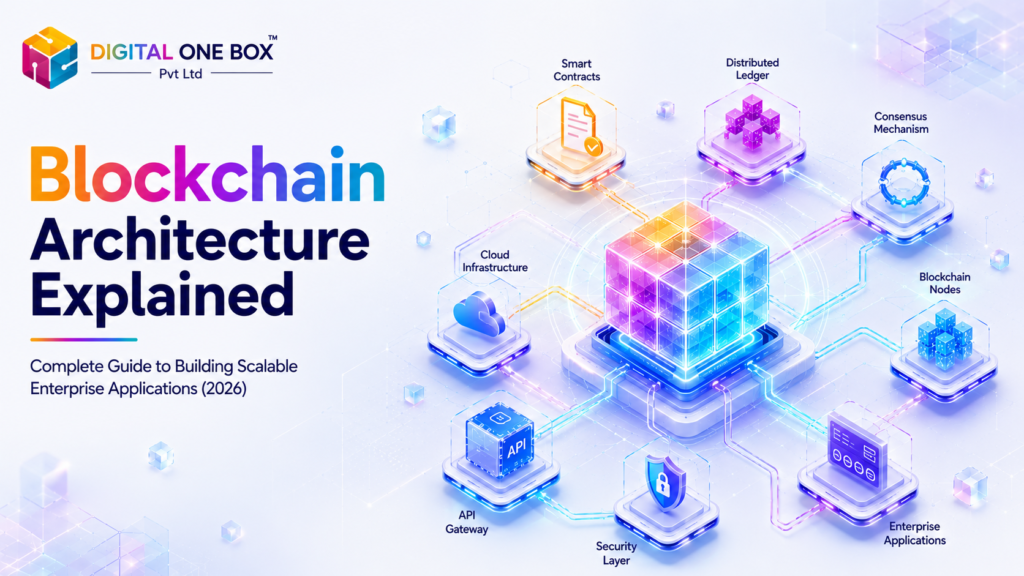
A modern enterprise blockchain architecture consists of multiple interconnected layers that work together to process transactions, execute smart contracts, and maintain consensus across the network.
Core Components of Blockchain Architecture
Every blockchain network relies on several fundamental components.
Distributed Ledger
The distributed ledger stores transaction records across multiple nodes rather than a central server. Every participant maintains a synchronized copy of the ledger, ensuring transparency and eliminating single points of failure.
Consensus Mechanism
Consensus mechanisms validate transactions and ensure all network participants agree on the current state of the blockchain.
Popular mechanisms include:
- Proof of Stake (PoS)
- Proof of Work (PoW)
- Practical Byzantine Fault Tolerance (PBFT)
- Proof of Authority (PoA)
Choosing the right consensus model depends on scalability, security, and business requirements.
Smart Contracts
Smart contracts are self-executing programs that automate business logic once predefined conditions are met.
They power applications such as:
- Digital payments
- Tokenization
- Supply chain automation
- NFT platforms
- Decentralized Finance (DeFi)
- Identity verification
Blockchain Nodes
Nodes maintain the blockchain network by validating, storing, and sharing transaction data.
Common node types include:
- Full Nodes
- Validator Nodes
- Archive Nodes
- Light Nodes
Together, they ensure network reliability and decentralization.
Cryptographic Security
Blockchain relies on cryptographic hashing, digital signatures, and public-private key encryption to protect data integrity and user identities, making unauthorized modifications virtually impossible
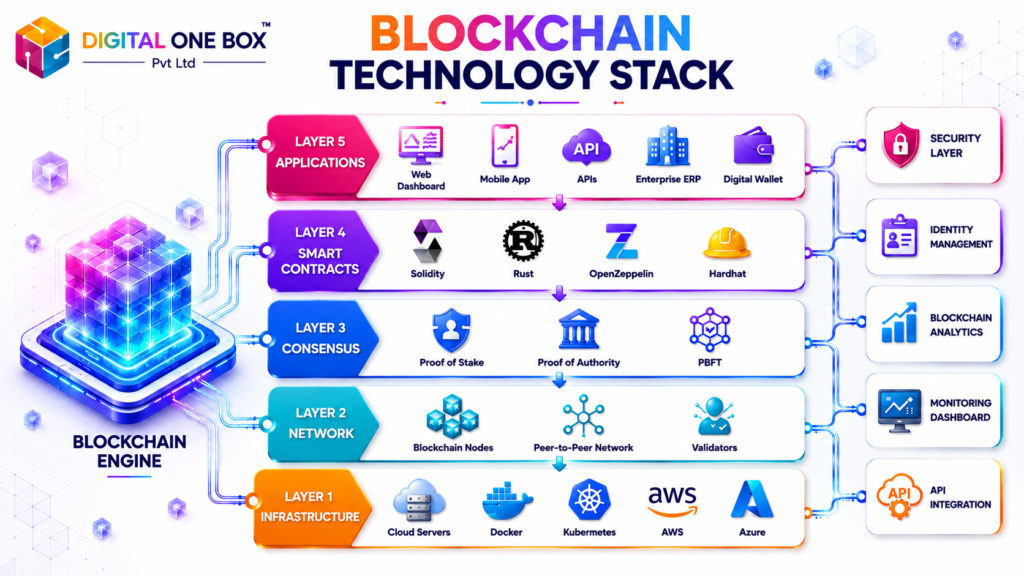
Understanding the layered architecture helps businesses design scalable and maintainable blockchain applications.
Infrastructure Layer
This layer includes cloud infrastructure, servers, networking, storage, and virtual machines that host blockchain nodes.
Technologies commonly used include AWS, Microsoft Azure, Google Cloud, Docker, and Kubernetes.
Network Layer
The network layer enables communication between blockchain nodes using peer-to-peer protocols, ensuring transactions propagate efficiently across the network.
Consensus Layer
This layer validates transactions, prevents double spending, and maintains trust without requiring a central authority.
Smart Contract Layer
Business rules are implemented using smart contracts written in languages such as Solidity or Rust, enabling secure automation and decentralized workflows.
Application Layer
The top layer includes decentralized applications (dApps), enterprise dashboards, wallet integrations, APIs, and user interfaces that interact with the blockchain.
Blockchain Technology Stack
Selecting the right blockchain technology stack is essential for building secure and scalable enterprise applications.
Frontend
- React.js
- Next.js
- Vue.js
- Flutter
Backend
- Node.js
- Go
- Python
- Java
Blockchain Platforms
- Ethereum
- Hyperledger Fabric
- Polygon
- Solana
- Avalanche
Smart Contract Development
- Solidity
- Rust
- OpenZeppelin
- Hardhat
- Foundry
Databases
- PostgreSQL
- MongoDB
- Redis
Cloud & DevOps
- AWS
- Microsoft Azure
- Docker
- Kubernetes
- Jenkins
- GitHub Actions
A modern technology stack should support performance, interoperability, and enterprise-grade security.
Blockchain Scalability Challenges
As blockchain adoption grows, scalability becomes a major consideration.
Common challenges include:
- Limited transaction throughput
- High network congestion
- Increased gas fees
- Storage growth
- Latency during peak usage
To overcome these issues, enterprises are adopting:
- Layer 2 scaling solutions
- Sidechains
- Rollups
- Efficient consensus algorithms
- Horizontal infrastructure scaling
- Optimized smart contracts
These approaches improve transaction speed while maintaining security and decentralization.
Blockchain Security Best Practices
Security is at the heart of successful blockchain development.
Organizations should implement:
- Multi-factor authentication (MFA)
- Role-based access control
- Smart contract audits
- Hardware Security Modules (HSM)
- Cold wallet integration
- Data encryption
- API security
- Continuous network monitoring
- Regular vulnerability assessments
Security should be integrated into every phase of the blockchain development lifecycle rather than treated as an afterthought.
Enterprise Use Cases of Blockchain
Blockchain is transforming industries by improving transparency, automation, and trust.
Some leading applications include:
- Financial transactions and cross-border payments
- Supply chain tracking
- Digital identity verification
- Healthcare record management
- Asset tokenization
- Insurance claims automation
- NFT marketplaces
- Web3 applications
- Government record management
- Enterprise document verification
As blockchain adoption expands, organizations continue discovering new ways to improve efficiency while reducing operational risks.
Why Choose Digital One Box for Blockchain Development?
Building enterprise blockchain applications requires expertise in distributed systems, cybersecurity, cloud infrastructure, and smart contract development.
At Digital One Box, we deliver end-to-end Blockchain Development Services designed to help businesses launch secure, scalable, and future-ready blockchain solutions.
Our expertise includes:
- Enterprise Blockchain Development
- Smart Contract Development
- Web3 Application Development
- Cryptocurrency Exchange Development
- Tokenization Solutions
- Blockchain Consulting
- AI + Blockchain Integration
- Cloud Infrastructure & DevOps
- Blockchain Security Audits
Whether you’re modernizing enterprise operations, developing decentralized applications, or launching a blockchain-powered product, our experienced team helps transform your vision into a production-ready solution.
Explore Our Related Services
- Blockchain Development Services
- AI Development Services
- Machine Learning Solutions
- Web3 Development
- Custom Software Development
- Cloud Application Development
Conclusion
Blockchain is reshaping how enterprises build secure, transparent, and scalable digital solutions. From distributed ledgers and smart contracts to advanced security and scalable infrastructure, a strong blockchain architecture forms the foundation of every successful blockchain application.
Businesses investing in blockchain today need more than just the right technology—they need a strategic partner capable of designing, developing, and maintaining enterprise-grade solutions that evolve with changing business requirements.
At Digital One Box, we combine technical expertise with industry experience to build secure, scalable, and future-ready blockchain platforms. Whether you’re planning a custom blockchain application, a Web3 ecosystem, or enterprise blockchain integration, our team is ready to help you accelerate innovation with confidence.
Frequently Asked Questions
What is blockchain architecture?
Blockchain architecture is the framework that defines how blockchain networks process transactions, validate data, execute smart contracts, and securely store information across distributed nodes.
Why is blockchain architecture important?
A well-designed blockchain architecture improves scalability, security, performance, interoperability, and long-term maintainability for enterprise applications.
Which industries use blockchain technology?
Blockchain is widely used in finance, healthcare, supply chain, retail, manufacturing, government, insurance, and digital identity management.
What technologies are used in blockchain development?
Common technologies include Ethereum, Hyperledger Fabric, Solidity, Rust, Node.js, React.js, Docker, Kubernetes, PostgreSQL, MongoDB, and cloud platforms such as AWS and Azure.