
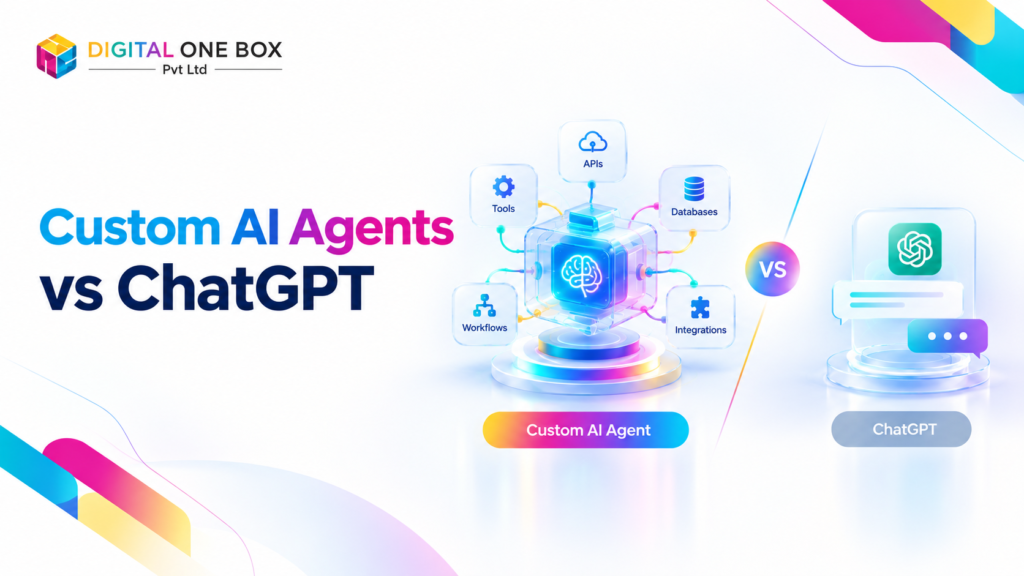
Businesses are moving beyond basic AI chat toward systems that can reason, use business data, connect with software, and complete tasks.
That creates an important question: Should your business use ChatGPT, or should you invest in custom AI agent development?
The answer depends on what you want AI to do.
ChatGPT is a powerful general-purpose AI assistant. A custom AI agent is designed around your company’s specific data, tools, processes, and objectives.
In simple terms:
ChatGPT helps people work with AI. Custom AI agents can be built to make business workflows work with AI.
ChatGPT vs Custom AI Agents: Quick Comparison
| Feature | ChatGPT | Custom AI Agent |
| General conversations | Excellent | Excellent |
| Content & research | Excellent | Excellent |
| Business-specific workflows | Limited/custom setup | Excellent |
| Private business data | Configurable | Fully customizable |
| CRM integration | Possible | Built around your CRM |
| API integrations | Available | Fully customizable |
| Autonomous actions | Increasingly capable | Designed for specific actions |
| Multi-step workflows | Possible | Core capability |
| Business rules | Limited/configurable | Fully customizable |
| Industry-specific behavior | Limited | Highly customizable |
| Workflow automation | Moderate–High | High |
| Enterprise control | Available | Fully customizable |
The distinction is increasingly about autonomy and execution. AI agents can reason about a task, use tools, interact with connected systems, and work through multi-step processes rather than simply generating a response. (Zendesk)
Want to build a custom ai agent go through – https://digitalonebox.com/custom-ai-solutions
What Is ChatGPT?
ChatGPT is a general-purpose Generative AI assistant designed to understand natural language and help users perform a wide range of tasks.
Businesses can use ChatGPT for:
- Content creation
- Market research
- Data analysis
- Brainstorming
- Coding assistance
- Document summarization
- Customer communication
- Internal knowledge assistance
- Business writing
For many companies, ChatGPT can be the easiest way to introduce Artificial Intelligence into everyday operations without developing an entire AI system.
However, a business may eventually need something more specialized.
For example, asking ChatGPT to analyze a lead is different from having an AI system that automatically finds the lead, checks the CRM, qualifies it, contacts the prospect, updates the CRM, and schedules a follow-up.
That is where custom AI agents become valuable.
What Is a Custom AI Agent?
A custom AI agent is an AI-powered software system designed to achieve a particular business objective.
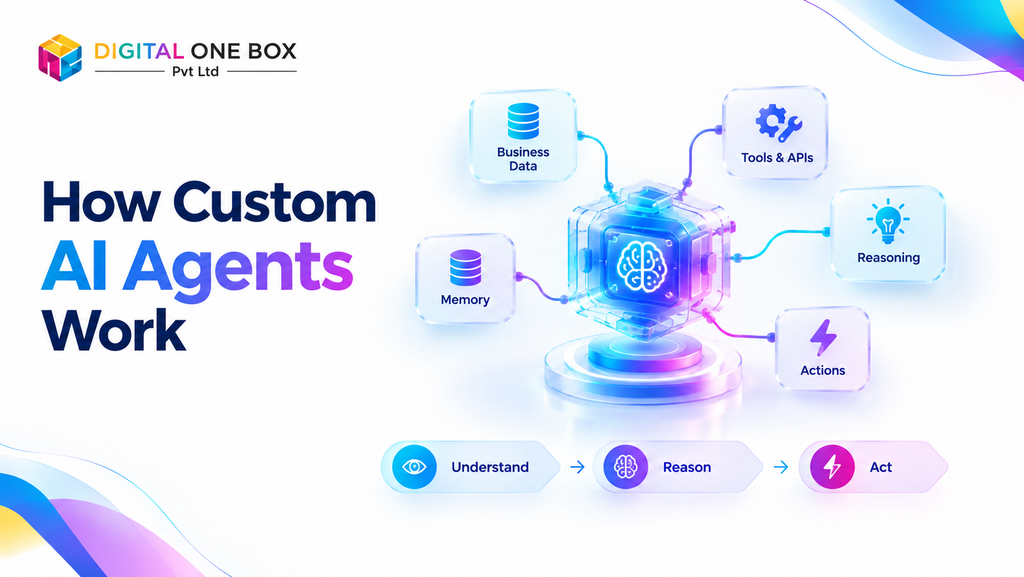
AI agents can combine reasoning with tools, business data, APIs, memory, workflows, and decision logic to perform tasks with limited human intervention. (IBM)
A custom AI agent may:
- Understand a user’s request
- Analyze available information
- Retrieve relevant business data
- Decide what needs to happen
- Use connected tools or APIs
- Execute actions
- Check the result
- Continue or escalate the workflow
Example: AI Sales Agent
Imagine a new lead arrives.
Traditional approach:
Lead → Salesperson → CRM → Follow-up → Meeting
Custom AI agent:
Lead → AI qualification → CRM lookup → Personalized outreach → Response analysis → CRM update → Follow-up → Meeting booking
The AI is not simply answering a question. It is participating in the business process.
Custom AI Agents vs ChatGPT: Key Differences
1. Purpose
ChatGPT is built for broad, flexible assistance.
A custom AI agent is built around a defined business objective.
For example:
ChatGPT:
“Write a follow-up email for this customer.”
AI Agent:
“Identify customers who haven’t responded in seven days, analyze their history, generate an appropriate follow-up, send it, and update the CRM.”
2. Autonomy
Autonomy is one of the biggest differences between traditional conversational AI and AI agents.
A chatbot or general AI assistant typically waits for a user request.
An AI agent can be designed to:
Perceive → Reason → Plan → Act → Verify → Continue
This makes agentic AI particularly relevant for business automation.
Modern AI agents are increasingly designed to plan, use tools, remember relevant context, and complete multi-step tasks. (Zendesk)
3. Business Data
ChatGPT can work with information provided to it through its available capabilities.
A custom AI agent can be specifically connected to a company’s:
- CRM
- ERP
- Databases
- Knowledge base
- Documents
- Customer records
- Product catalog
- Internal APIs
- Business applications
This enables companies to build AI agents for business around their own operational data.
4. Integrations
A major reason companies choose custom AI development is integration.
A custom AI agent can be designed to interact with systems such as:
- Salesforce
- HubSpot
- Custom CRM
- Telephony
- Payment platforms
- ERP systems
- Databases
- Internal applications
- Blockchain networks
- Third-party APIs
The agent becomes an intelligence layer connecting different parts of the business.
5. Workflow Automation
ChatGPT can help employees perform tasks.
A custom AI agent can be designed to automate the workflow itself.
For example:
Customer message → Intent detection → Customer lookup → Decision → Action → Confirmation → CRM update
This is why AI workflow automation is becoming an important application of agentic AI.
6. Custom Business Logic
Every company has different rules.
A custom AI agent can incorporate:
- Approval rules
- Customer segmentation
- Pricing rules
- Escalation conditions
- Permissions
- Industry requirements
- Internal processes
- Decision criteria
Instead of asking employees to repeatedly explain how a process works, those rules can become part of the AI system.
AI Agents for Business: Real-World Use Cases
Customer Support
ChatGPT: Answers customer questions.
Custom AI Agent: Can understand the issue, retrieve customer information, check policies, update records, initiate approved actions, and escalate when necessary.
Sales & Lead Generation
An AI sales agent can:
- Qualify leads
- Research prospects
- Update CRM records
- Send personalized messages
- Schedule meetings
- Trigger follow-ups
- Prioritize high-value leads
E-commerce
A custom AI agent can connect customer conversations with inventory, orders and customer data.
For example:
“Where is my order?”
Instead of simply explaining the tracking process, the agent could retrieve the order, check its status and provide the customer with the relevant information.
Finance
AI agents can assist with:
- Financial document processing
- Report generation
- Data analysis
- Internal workflows
- Compliance processes
- Business intelligence
Human approval can remain part of workflows where decisions require additional oversight.
Web3 & Blockchain
Custom AI agents can also be applied to Web3 applications.
Potential use cases include:
- Blockchain data analysis
- Smart contract monitoring
- AI-powered DApps
- Crypto trading workflows
- Web3 customer support
- Wallet activity analysis
- Token ecosystem analytics
This creates opportunities for businesses combining AI + Blockchain technologies.
When Should a Business Choose ChatGPT?
ChatGPT may be the better choice when your primary requirements are:
- Employee productivity
- Content creation
- Research
- Brainstorming
- Coding assistance
- General data analysis
- Basic customer assistance
- Everyday AI adoption
If you simply need an intelligent AI assistant, building a custom system may be unnecessary.
When Should You Build a Custom AI Agent?
Consider custom AI agent development when your business needs:
- Complex workflows
- CRM or ERP integration
- Private company data
- Autonomous task execution
- Multiple system integrations
- Industry-specific logic
- Automated customer journeys
- AI-powered sales processes
- Continuous workflow automation
- Greater control over AI behavior
The more your requirements move from “answer my question” toward “complete this business process,” the stronger the case for a custom AI agent becomes.
Custom AI Agents, Agentic AI & AI Automation
The evolution of business AI can be viewed roughly as:
Generative AI → AI Assistants → AI Agents → Agentic AI → Multi-Agent Systems
Generative AI primarily creates content.
AI assistants help users accomplish tasks.
AI agents can be designed to perform tasks using tools and connected systems.
Agentic AI goes further by emphasizing planning, decision-making and autonomous execution across workflows.
The result is a shift from:
AI that generates → AI that performs.
GPT-6 Astra vs Custom AI Agents
The arrival of GPT-6 Astra makes this distinction even more interesting.
OpenAI describes GPT-6 Astra as its most capable model, with advanced capabilities across reasoning, computer use, browsing, software engineering, cybersecurity, science and professional work. It is also designed to handle complex multi-step workflows. (OpenAI)
The important point is that GPT-6 Astra and a custom AI agent are not necessarily alternatives.
A powerful model such as GPT-6 Astra can serve as the reasoning or intelligence layer inside a custom AI agent.
A complete business agent can then add:
AI Model + Business Data + Tools + APIs + Memory + Permissions + Workflow Logic + Monitoring
This architecture allows businesses to build AI around their own processes rather than simply giving employees access to a general-purpose model.
OpenAI currently lists GPT-6 Astra API pricing at $10 per million input tokens and $50 per million output tokens, making model usage one factor to consider when estimating custom AI agent operating costs. (OpenAI Developers)
How to Build a Custom AI Agent
A practical AI agent development process can follow these steps:
1. Identify the Business Problem
Determine which process should be improved or automated.
2. Define the Agent’s Responsibilities
Specify what the agent can and cannot do.
3. Connect Business Data
Integrate CRM, documents, databases and knowledge sources.
4. Select the AI Model
Choose the appropriate model based on reasoning, speed, cost and task complexity.
5. Build Tools & Integrations
Connect APIs, software platforms and business systems.
6. Add Memory & Knowledge
Give the agent appropriate context and retrieval capabilities.
7. Implement Workflow Logic
Define actions, conditions, approvals and escalation paths.
8. Test & Secure
Test accuracy, permissions, reliability and failure scenarios.
9. Deploy & Monitor
Track performance, costs, errors and business outcomes.
How Much Does Custom AI Agent Development Cost in 2026?
There is no single AI agent development cost because the architecture can range from a simple task-focused agent to a complex enterprise system.
Major cost factors include:
- AI model usage
- Number of integrations
- Workflow complexity
- RAG and knowledge systems
- Database requirements
- Voice capabilities
- Cloud infrastructure
- Security requirements
- Monitoring
- Number of users
- Ongoing maintenance
A basic internal AI assistant can be relatively simple, while a production-grade autonomous AI platform connected to CRM, WhatsApp, telephony and multiple enterprise systems requires considerably more engineering.
Why Choose Digital One Box for Custom AI Agent Development?
Businesses looking beyond generic AI tools can work with Digital One Box to design AI solutions around their specific workflows.
Digital One Box can support custom AI initiatives including:
- AI Agent Development
- AI Chatbot Development
- AI Workflow Automation
- AI + Blockchain Integration
- AI-powered DApps
- AI Trading Bot Development
- Enterprise AI Solutions
The goal is not simply to add an AI model to an application. The larger objective is to connect AI intelligence with business data, systems and workflows.
FAQs
Is a custom AI agent better than ChatGPT?
Not always. ChatGPT is excellent for general-purpose AI assistance, while custom AI agents are better suited to specialized workflows, integrations and autonomous business processes.
What is the difference between ChatGPT and an AI agent?
ChatGPT is a general-purpose AI assistant. An AI agent is designed to use reasoning, tools and connected systems to accomplish specific tasks or workflows.
Can a custom AI agent use GPT-6 Astra?
Yes. A custom AI agent can potentially use a foundation model such as GPT-6 Astra as part of its AI architecture, with additional business-specific tools, data and workflow logic.
How much does it cost to build an AI agent?
The cost depends on complexity, integrations, AI model usage, data requirements, security and infrastructure. There is no universal fixed price.
Can AI agents connect with CRM and WhatsApp?
Yes. Custom AI agents can be designed to integrate with CRM platforms, WhatsApp solutions, email, telephony, databases and other APIs.
What is Agentic AI?
Agentic AI refers to AI systems capable of reasoning about objectives, planning actions and using tools to accomplish tasks with varying degrees of autonomy.
Should startups build an AI agent or use ChatGPT?
Startups should generally begin with ChatGPT when they need general AI assistance. A custom AI agent becomes more valuable when AI needs to operate inside the startup’s specific workflows and software.