
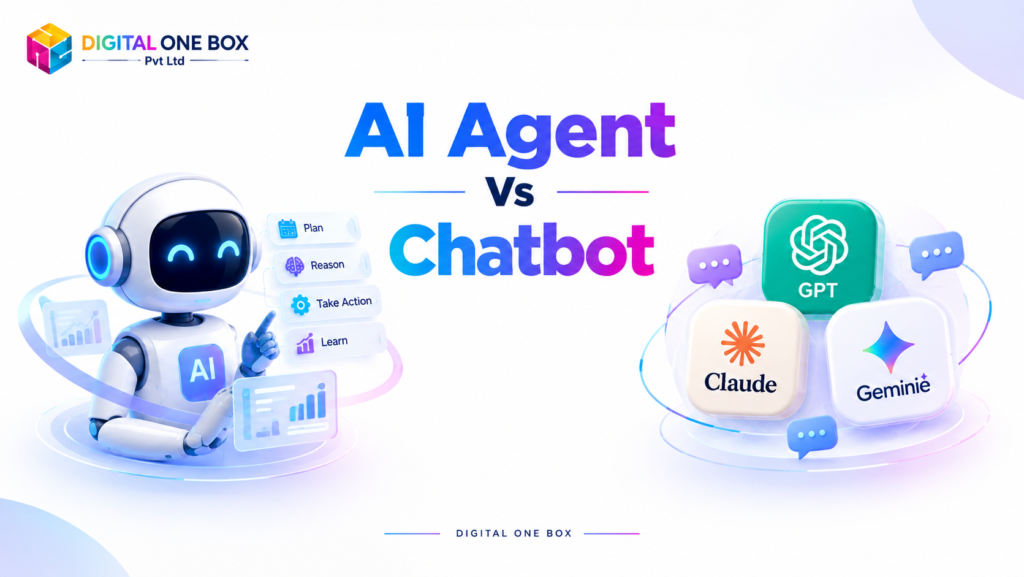
AI is moving beyond simple conversations. Businesses are now using AI agents, AI chatbots, generative AI, and agentic AI to automate customer support, sales, internal operations, research, and complex workflows.
But one question continues to create confusion:
What is the difference between an AI agent and a chatbot?
Although both can use large language models (LLMs), they are designed for different levels of autonomy. A chatbot primarily communicates with users, while an AI agent can reason, use tools, make decisions, and complete multi-step tasks.
With increasingly capable models such as GPT-6 Astra, the distinction is becoming even more important as AI systems move toward autonomous computer use and end-to-end task execution. OpenAI describes GPT-6 Astra as capable of complex reasoning, browsing, software engineering, computer use, research, and professional work.
So, AI agent vs chatbot—which is better for your business?
The answer depends on what you want the AI to accomplish.
What Is an AI Chatbot?
An AI chatbot is a conversational AI system designed to communicate with users through text or voice.
Modern AI chatbots can understand natural language, answer questions, retrieve information from a knowledge base, and provide personalized responses.
Common AI chatbot use cases include:
- Customer support
- Website assistance
- Lead generation
- FAQs
- Product recommendations
- Appointment scheduling
- Internal knowledge search
- Customer service automation
For example, a customer might ask:
“What is the status of my order?”
A chatbot can retrieve the relevant information and respond.
However, traditional or basic chatbots generally stop after providing the response.
What Is an AI Agent?
An AI agent goes beyond conversation.
An AI agent is an autonomous AI system capable of understanding a goal, reasoning through the required steps, using external tools or APIs, and executing actions.
For example, instead of simply telling a customer their order is delayed, an AI agent could:
- Check the order management system.
- Identify the reason for the delay.
- Check available inventory.
- Contact the logistics API.
- Offer an alternative delivery option.
- Update the CRM.
- Notify the customer.
That ability to reason, plan and act is the fundamental difference between an AI agent and a chatbot.
Current enterprise comparisons similarly distinguish chatbots as primarily conversational systems from agents that can make decisions and execute multi-step workflows.
AI Agents vs Chatbots: Key Differences
| Feature | AI Chatbot | AI Agent |
| Primary purpose | Conversation | Task completion |
| Interaction | Reactive | Proactive/goal-driven |
| Autonomy | Low to moderate | High |
| Reasoning | Basic to advanced | Multi-step reasoning |
| Tool/API access | Limited | Extensive |
| Workflow automation | Limited | Advanced |
| Memory | Usually session-based | Can use persistent/contextual memory |
| Decision-making | Limited | Goal-oriented |
| Multi-step tasks | Limited | Strong |
| Business integrations | Basic | CRM, ERP, APIs, databases and other systems |
| Human involvement | Often required for complex requests | Can operate autonomously within guardrails |
| Best for | Questions and conversations | Automation and execution |
The key distinction can be summarized simply:
Chatbots answer. AI agents act.
AI Agent vs AI Chatbot: How They Work Differently
A chatbot typically follows:
User Input → AI Model → Response
An AI agent follows a more advanced loop:
Goal → Reason → Plan → Use Tools → Execute → Observe → Adjust → Complete
This agentic workflow allows AI agents to handle tasks that cannot be completed with a single response.
For example:
Chatbot:
“Your refund policy allows returns within 30 days.”
AI Agent:
“I found your order, verified that it is eligible for a refund, submitted the request, updated your ticket, and sent the confirmation.”
That difference makes AI agent development particularly valuable for businesses trying to automate complete processes rather than simply improve conversations.
AI Agents vs Chatbots for Business Use Cases
Choose an AI Chatbot When:
An AI chatbot may be the better option when your primary objective is communication.
Ideal use cases include:
- FAQ automation
- Website customer support
- Product information
- Lead qualification
- Basic sales assistance
- Knowledge-base search
- Customer onboarding
If customers mainly need answers, a chatbot can provide an efficient and cost-effective solution.
Choose an AI Agent When:
An AI agent becomes more valuable when the AI needs to perform actions.
Common AI agent use cases include:
- Sales automation
- Customer service resolution
- CRM automation
- AI workflow automation
- Research automation
- Appointment management
- Document processing
- Financial workflows
- IT operations
- Supply-chain automation
- Autonomous business processes
For example, an AI agent can connect with CRM software, email, databases, payment systems and business APIs to complete an entire workflow.
AI Agents, Chatbots and Agentic AI
Another important term businesses are searching for is agentic AI.
Agentic AI refers to AI systems designed to pursue goals, make decisions, use tools and execute actions with varying degrees of autonomy.
This means an AI chatbot can become part of an agentic system—but simply adding an LLM to a chatbot does not automatically make it an AI agent.
The architecture and capabilities matter.
This distinction is increasingly important as modern AI models become capable of computer use, browsing, coding and multi-step professional tasks. GPT-6 Astra, for example, is positioned by OpenAI as a model for complex end-to-end work and computer interaction.
GPT-6 Astra and the Evolution of AI Agents
The arrival of GPT-6 Astra highlights where AI agent development is heading.
Instead of AI systems only generating text, advanced models can increasingly interact with software environments and perform tasks.
OpenAI reports that GPT-6 Astra can handle activities such as updating CRM records, filling online forms, conducting research, creating websites and performing software-related tasks.
For businesses, this creates an opportunity to build AI solutions where the model is not simply the conversational interface—it becomes the reasoning layer inside a broader automated workflow.
This makes keywords such as GPT-6 Astra AI agents, AI agent development, agentic AI, AI automation, and custom AI agents increasingly relevant to enterprise AI strategies.
AI Agent vs Chatbot: Which One Should Your Business Choose?
Use this simple decision framework:
Choose a chatbot if:
- You mainly need answers.
- Your workflows are simple.
- Users need conversational assistance.
- You want fast deployment.
- Complex system integration isn’t required.
Choose an AI agent if:
- The AI needs to perform actions.
- Multiple systems need to be connected.
- Workflows involve multiple steps.
- Decisions need to be made dynamically.
- You want greater business process automation.
- The AI needs to operate toward a defined goal.
In many cases, businesses don’t need to choose only one.
A powerful architecture can combine AI chatbots + AI agents.
For example, the chatbot can act as the customer-facing interface while an AI agent works behind the scenes to retrieve data, update systems and execute workflows.
How Digital One Box Helps Businesses Build AI Solutions
The right AI architecture depends on your business process, data, integrations and automation requirements.
Digital One Box helps businesses design and develop custom AI solutions ranging from conversational AI to autonomous AI workflows.
Our AI capabilities include:
- AI Agent Development
- AI Chatbot Development
- AI Workflow Automation
- AI + Web3 Solutions
- AI Blockchain Integration
- AI-powered DApps
- AI Trading Bot Development
For businesses that need more than a basic chatbot, custom AI agent development can connect LLMs with CRM systems, APIs, databases, enterprise software and business workflows.
Final Verdict: AI Agent or Chatbot?
There is no universal winner in the AI agent vs chatbot debate.
The right technology depends on your objective.
Chatbots are best for conversations. AI agents are best for actions and workflows.
If your customers simply need information, an AI chatbot may be enough. If you want AI to reason, make decisions, interact with business systems and complete multi-step processes, an AI agent is usually the stronger choice.
And as models such as GPT-6 Astra push AI toward more capable computer use and autonomous task execution, the future of enterprise AI is increasingly moving from “AI that answers” to “AI that gets work done.”
Frequently Asked Questions
Are AI agents better than chatbots?
Not always. Chatbots are better for conversational support and information retrieval, while AI agents are better for autonomous workflows and multi-step task execution.
What is the main difference between an AI agent and a chatbot?
The primary difference is autonomy. Chatbots mainly respond to users, while AI agents can reason, use tools and take actions to achieve a goal.
Can an AI chatbot become an AI agent?
Yes. A chatbot can become part of an AI agent architecture when it is connected to tools, APIs, memory, decision-making logic and autonomous workflows.
What is agentic AI?
Agentic AI refers to AI systems capable of pursuing goals, reasoning through tasks, using tools and taking actions with varying levels of autonomy.
Is GPT-6 Astra an AI agent?
GPT-6 Astra is an AI model, not automatically an AI agent. However, its advanced reasoning, computer-use and tool capabilities can serve as the intelligence layer within AI agent applications.