
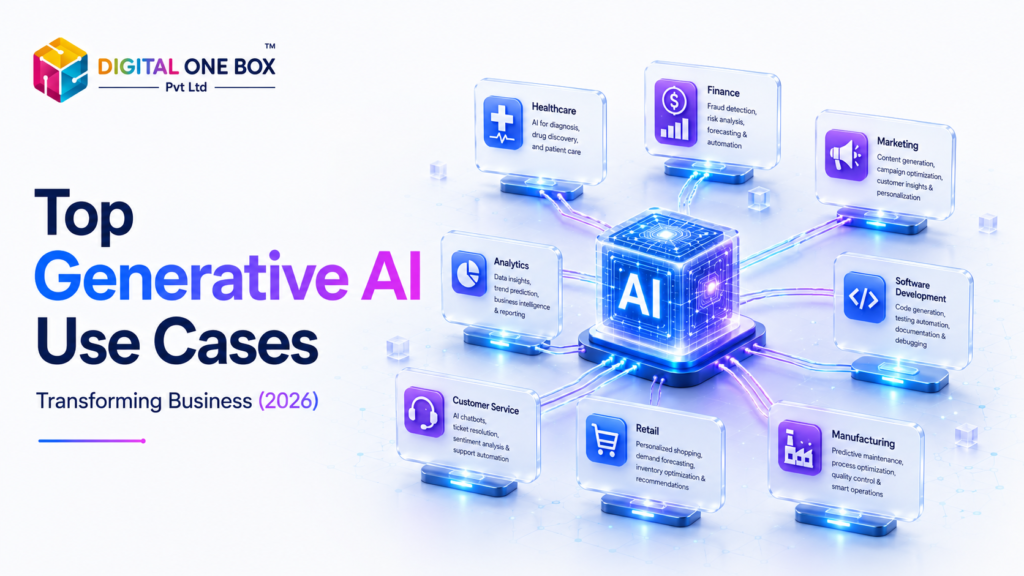
Generative AI has evolved from an emerging technology into a strategic business enabler. Organizations across industries are using AI-powered solutions to automate workflows, enhance customer experiences, accelerate innovation, and improve operational efficiency.
Unlike traditional AI, which focuses on prediction and analysis, Generative AI creates new content—including text, code, images, videos, and synthetic data—based on learned patterns. As businesses embrace digital transformation, understanding the most impactful Generative AI use cases is essential for staying competitive. Source (Digital One Box)
In this guide, we’ll explore how enterprises are leveraging Generative AI across healthcare, finance, marketing, software development, and other industries, while highlighting how Digital One Box helps organizations build secure, scalable AI solutions.
Why Businesses Are Investing in Generative AI
Generative AI helps businesses reduce repetitive work, improve productivity, and accelerate decision-making. From creating marketing campaigns to generating software code and analyzing medical records, AI enables teams to focus on higher-value activities.
Some of the biggest business benefits include:
- Increased operational efficiency
- Faster content creation
- Better customer personalization
- Improved decision-making
- Lower operational costs
- Scalable automation
- Enhanced innovation
These advantages make Generative AI one of the fastest-growing enterprise technologies in 2026.
Generative AI in Healthcare & Pharma
Healthcare organizations are increasingly adopting Generative AI to improve patient care, accelerate research, and optimize clinical workflows.
Medical Imaging & Drug Discovery
AI models assist researchers by analyzing medical images, identifying disease patterns, and accelerating drug discovery. Generative AI can simulate molecular structures, reducing research time while improving treatment development.
Hospitals also use AI-assisted diagnostics to support clinicians with faster and more accurate decision-making.
Privacy-Safe Patient Data
Access to patient data is essential for AI innovation, but privacy regulations remain a challenge. Generative AI creates synthetic datasets that replicate real-world patterns without exposing sensitive patient information.
This enables secure research, AI model training, and healthcare innovation while maintaining regulatory compliance.
Finance and Trading Applications
Financial institutions rely on AI to improve security, automate operations, and enhance customer experiences.
Algorithmic Trading & Market Simulation
Generative AI helps financial organizations simulate market scenarios, optimize trading strategies, and improve forecasting models.
Investment firms use AI-generated simulations to evaluate risk before making trading decisions.
Fraud Detection & Risk Modeling
AI continuously analyzes transaction behavior, detects anomalies, and identifies fraudulent activities before financial losses occur.
Combined with predictive analytics, Generative AI helps banks improve credit scoring, regulatory compliance, and enterprise risk management.
Marketing & Content Creation
Marketing is one of the most mature enterprise applications of Generative AI.
Automated Content Generation
Businesses use AI to create:
- Blog articles
- Product descriptions
- Social media posts
- Marketing emails
- Ad copy
- Videos
- Images
This significantly reduces production time while maintaining consistent brand messaging.
Personalized Customer Experiences
Generative AI analyzes customer behavior to deliver personalized product recommendations, dynamic website experiences, and targeted marketing campaigns.
This leads to improved engagement, higher conversion rates, and stronger customer loyalty.
Software Development & IT Operations
Software teams are using Generative AI to improve development speed and code quality.
AI Code Generation & Review
AI coding assistants help developers generate code snippets, identify bugs, review pull requests, and automate repetitive programming tasks.
This enables engineering teams to deliver software faster while maintaining code quality.
AI-Powered Knowledge Management
Organizations generate vast amounts of technical documentation. Retrieval-Augmented Generation (RAG) enables AI to retrieve enterprise knowledge from internal systems, allowing employees to receive accurate, context-aware answers instantly.
This improves productivity across engineering, HR, customer support, and operations.
Retail, Manufacturing & Customer Service
Generative AI continues to reshape customer-facing industries.
Retail businesses use AI for demand forecasting, personalized shopping experiences, and automated product descriptions.
Manufacturers leverage AI to optimize production schedules, generate predictive maintenance insights, and improve quality assurance.
Customer service teams deploy AI-powered virtual assistants capable of resolving common support requests, reducing response times while improving customer satisfaction.
These GenAI business applications enable organizations to scale operations without increasing operational costs.
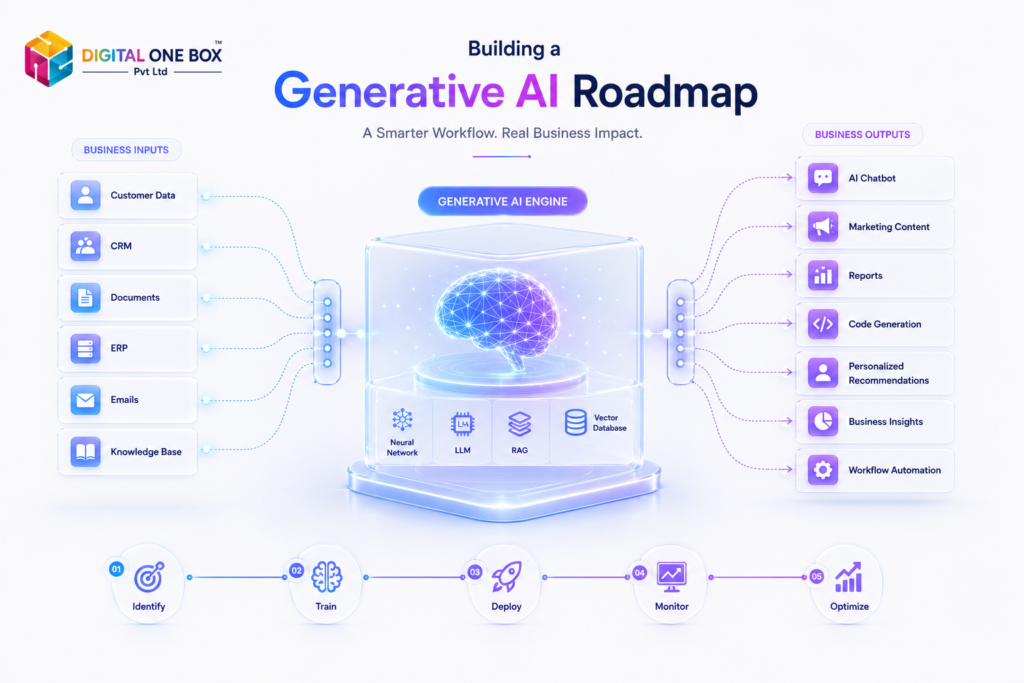
Successful AI adoption starts with identifying business problems rather than implementing technology for its own sake.
Identify High-Value Workflows
Focus on repetitive, time-consuming tasks where AI can deliver measurable improvements.
Examples include:
- Customer support
- Document processing
- Marketing automation
- Internal knowledge search
- Software development
- Financial reporting
Prioritizing high-impact workflows ensures faster ROI and smoother enterprise adoption.
Choose the Right Technology Partner
Building enterprise AI solutions requires expertise in machine learning, cloud infrastructure, data engineering, security, and compliance.
Partnering with experienced AI specialists helps organizations reduce implementation risks while accelerating deployment.
Why Choose Digital One Box for Generative AI Development?
At Digital One Box, we help businesses unlock the full potential of Generative AI through custom, enterprise-ready solutions tailored to their goals.
Our expertise includes:
- Custom Generative AI Development
- AI Chatbots & Virtual Assistants
- Machine Learning Solutions
- AI Workflow Automation
- Retrieval-Augmented Generation (RAG)
- AI Integration with Enterprise Applications
- Natural Language Processing (NLP)
- AI Strategy & Consulting
Whether you’re automating internal operations, enhancing customer experiences, or building AI-powered products, our team delivers secure, scalable, and future-ready solutions.
Related Services
- AI Development Services
- Machine Learning Solutions
- Custom Software Development
- Cloud Application Development
- Data Analytics Solutions
Conclusion
Generative AI is transforming how businesses innovate, automate, and compete. From healthcare and finance to marketing, software development, and customer service, organizations are using AI to improve efficiency, reduce costs, and create exceptional customer experiences.
As adoption accelerates, businesses that implement well-planned AI strategies will gain a significant competitive advantage.
Digital One Box empowers organizations to embrace Generative AI with secure, scalable, and customized solutions designed for long-term growth. Whether you’re exploring your first AI initiative or scaling enterprise-wide automation, our experts are ready to help you turn AI into measurable business value.
Frequently Asked Questions
What are the top Generative AI use cases?
The most common Generative AI use cases include content creation, software development, healthcare research, fraud detection, customer service automation, marketing personalization, and enterprise knowledge management.
Which industries benefit most from Generative AI?
Healthcare, finance, retail, manufacturing, software development, education, and customer support are among the industries experiencing the greatest business impact.
Is Generative AI suitable for small businesses?
Yes. Cloud-based AI platforms make Generative AI accessible for businesses of all sizes, enabling automation, improved productivity, and better customer engagement without significant infrastructure investments.